
Before There Was a Classroom, There Was Her Voice
How Black women have carried knowledge, culture, discipline and survival from one generation to the next.
BY SHABAZZ | KOURAGE & KULTURE
FOUR LAW FOCUS: TELL THE TRUTH • RESPECT THE BUILDER • SUPPORT THE BUSINESS • PROTECT THE LEGACY
The Author of the Universe
Before there was a nation, a school system, a written constitution or a Western definition of civilization, there was the Black woman.
She is the original portal through which humanity entered the physical world. Within her body, unseen intelligence transforms blood, breath, nourishment and ancestral memory into new life. She carries the ability to receive a seed, surround it with protection and deliver consciousness into the universe.
This is why her teaching begins before birth.
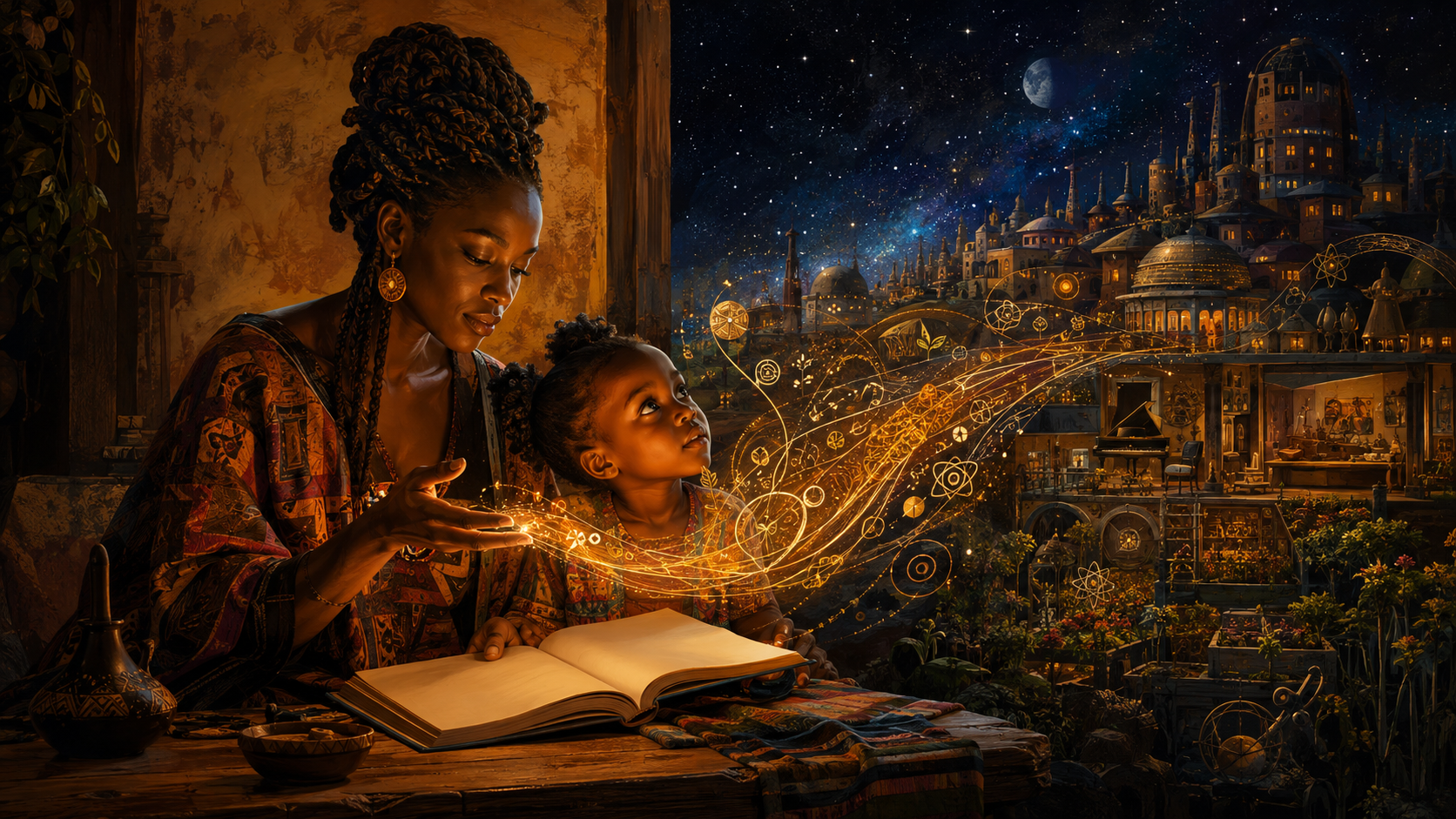
A child first experiences rhythm through her heartbeat. The child encounters sound through her voice, movement through her body and nourishment through what she provides. Before the newborn sees the sun, the moon or the faces of family, the Black woman has already introduced that life to vibration, protection and relationship.
She is not merely a participant in creation. She is its earthly author.
Across ancient African civilizations, the feminine principle was associated with creation, wisdom, fertility, protection, justice and cosmic balance. African societies recognized that life depends upon the union of forces—and that the power to bring unseen possibility into visible form is sacred.
The Black woman studied the heavens, cultivated the earth, preserved medicinal knowledge, developed agriculture, shaped language, organized families and helped establish the moral order of the community. Her intelligence was practical, spiritual, scientific and artistic at the same time. She did not separate the classroom from creation because the universe itself was the classroom.
She read the seasons. She understood the movements of water. She recognized the healing properties of plants. She observed birth, death and renewal. She translated those observations into knowledge that allowed families and civilizations to endure.
To call the Black woman the first teacher is not simply to say that she taught the first child.
It is to recognize her as the bridge between the invisible and the visible, the ancestral and the unborn, the earth beneath our feet and the stars above our heads.
She is the keeper of the portal.
She is the first library.
She is the author of the universe.
Before a child enters a classroom, opens a textbook or learns the name of a teacher, education has already begun.
It begins with a voice.
The voice that teaches a child how to speak. The hands that demonstrate how to wash, dress, prepare food and care for others. The stories that explain who the family is, where it came from and what it has survived. The correction that establishes discipline. The encouragement that plants confidence before the world has an opportunity to produce doubt.
For generations, the Black woman has carried this responsibility.
She has taught inside homes, churches, fields, kitchens, community centers and classrooms. She has passed knowledge through songs, prayers, proverbs, recipes, rituals, warnings and personal example. Even when laws denied Black people access to formal education, she continued educating children through memory, observation and experience.
She taught them how to survive—but survival was never the limit of her instruction.
She taught dignity under conditions designed to produce humiliation. She protected culture when displacement and oppression attempted to erase it. She taught children to recognize their worth before society acknowledged their humanity.
The Black woman was not waiting for permission to become an educator.
She was already teaching.
Her First Classroom Was the Home
Long before formal schools became available to Black children, education was taking place inside the family.
Black mothers and grandmothers taught children how to communicate, solve problems, complete responsibilities and understand the world around them. They taught through repetition, correction and example. Every task carried a lesson.
Preparing food taught patience, measurement and cooperation. Caring for younger children taught responsibility. Listening to elders taught respect and memory. Working beside family members taught discipline and the importance of contributing to something larger than oneself.
The home was not separate from education. It was the foundation of education.
In African societies, knowledge was often transferred through community life. Children learned by watching skilled adults, listening to oral histories, participating in ceremonies and gradually accepting greater responsibilities. Education prepared them to understand their place within the family, the community and the natural world.
The Black woman stood at the center of much of that preparation. She carried language, family history, spiritual understanding and practical knowledge from one generation to the next.
Her lessons did not always come from a book, but they carried the information a child needed to live, belong and become useful to the community.
Teaching Was an Act of Resistance
During slavery, education became dangerous because knowledge threatened the system’s control.
Laws in several slaveholding states restricted or criminalized teaching enslaved Black people to read and write. Slaveholders understood that literacy could help an enslaved person communicate, organize, study the Bible independently, recognize deception, write a travel pass or pursue freedom.
But the absence of a legal classroom did not mean the absence of education.
Black women continued teaching children through spoken history, spiritual traditions, coded language, songs and survival strategies. They taught which places were dangerous, whom to trust, how to protect younger family members and how to preserve an inner sense of identity inside a system built to reduce human beings to property.
Some learned to read secretly and shared what they knew. Others preserved knowledge through memory because written records were unavailable or unsafe.
Teaching a Black child that they possessed dignity was itself an act of resistance. Keeping family history alive challenged a system that separated relatives and attempted to erase ancestral connections.
Every lesson carried a message: You are more than what this system calls you. You belong to a people. Your life has meaning.
Under oppression, the Black woman’s classroom could exist anywhere—and her teaching helped keep the people spiritually and culturally alive.
When Freedom Came, She Built Schools
After emancipation, Black women carried their teaching power into schools, churches, political meetings, newspapers and movements for liberation.
But their work did not begin with freedom. Women such as Sojourner Truth had already transformed their lived experience into public education. Born into slavery as Isabella Baumfree, she escaped bondage and renamed herself Sojourner Truth to represent her spiritual mission. Although she could not read or write, she became a commanding orator, abolitionist and defender of women’s rights.
Truth turned her voice into a classroom.
She confronted slavery, racism, sexism and religious hypocrisy before audiences that often refused to recognize the full humanity of a Black woman. She demonstrated that literacy and intelligence are not identical, and that wisdom can emerge through experience, spiritual conviction, observation and courage.
After slavery, formerly enslaved Black people moved rapidly to establish schools. Education was understood as one of the clearest pathways from forced dependence toward freedom, citizenship and self-determination.
Black women became teachers, fundraisers, organizers and institution builders.
They taught children during the day and adults at night. They worked inside churches, one-room schoolhouses and community buildings with limited books, supplies and financial support. Families contributed labor, land and whatever money they could gather because they understood that freedom without knowledge remained vulnerable.
Mary McLeod Bethune transformed her commitment to educating Black girls into a school that eventually became Bethune-Cookman University. Anna Julia Cooper taught that the education and advancement of Black women strengthened an entire people. Septima Poinsette Clark developed citizenship schools that helped Black adults gain the literacy and civic knowledge necessary to confront voter suppression.
These women were not simply preparing students to find employment. They were preparing people to defend their rights, participate in public life, create institutions and determine their own future.
They carried the same creative force that produces life and used it to produce movements, schools, leaders and new possibilities.
When the Black woman was denied entry, she built another door.
When her people were denied a classroom, she created one.
When history tried to silence her, she transformed her voice into living knowledge.
Scientist, Healer and Keeper of the Earth
The Black woman’s knowledge has never been limited to words on a page.
Across Africa and throughout the Black world, women studied the relationship between the human body, the earth, water, food, birth and spiritual well-being. They learned by observing patterns, testing what worked and passing proven knowledge from one generation to the next.
She knew which plants could nourish the body, soothe pain, clean wounds or support a woman during childbirth. She understood that food could serve as both medicine and memory. She preserved seeds, cultivated crops and developed methods of preparing, storing and sharing food that helped communities survive changing seasons.
As a midwife, she stood at the doorway between worlds. She guided mothers through pregnancy, labor and recovery while welcoming new life into the family. Her knowledge joined anatomy, experience, intuition, emotional support and spiritual understanding.
As a healer, she recognized that illness could affect more than the body. A person could also suffer from grief, isolation, fear, displacement or the loss of cultural connection. Healing required attention to the whole human being.
This was science before institutions attempted to claim exclusive ownership of science.
It was the disciplined study of nature, cause, effect, balance and survival. It was knowledge built through generations of observation and protected within the living libraries of Black women.
Much of this wisdom was dismissed, stolen or renamed by systems that refused to credit its original guardians. But the knowledge survived—in gardens, kitchens, birth rooms, ceremonies and the hands of grandmothers who remembered what official institutions had forgotten.
The Black woman did not merely exist within nature.
She studied it, worked with it and taught humanity how to live through it.
Teacher of Kings and Builder of Civilizations
The Black woman has never existed only behind history’s great leaders. She has also stood among them.
She advised families, councils, warriors, spiritual communities and governments. She taught children who would become farmers, healers, builders, artists, defenders and rulers. Her influence shaped leadership long before official records decided whose names deserved preservation.
African history carries the presence of women whose intelligence moved nations.
Hatshepsut ruled ancient Kemet during a period marked by monumental building and expanded trade. Kandake Amanirenas of Kush led resistance against Roman expansion. Queen Nzinga used diplomacy, military strategy and political intelligence to defend her people against Portuguese domination. Yaa Asantewaa helped lead the Asante resistance against British colonial power.
These women were not historical accidents. They emerged from cultures in which Black women could develop knowledge, exercise authority and accept responsibility for the survival of their people.
Behind every remembered queen stood communities of women whose names may never appear in textbooks: mothers who prepared leaders, elders who preserved political memory, spiritual teachers who established moral responsibility and women who kept society functioning during war, migration and crisis.
The Black woman taught that leadership was not decoration. It was obligation.
Power carried a duty to protect the vulnerable, preserve the people’s resources and prepare the next generation. A leader who forgot the community had misunderstood the purpose of authority.
She did not merely teach kings how to rule.
She reminded power whom it was supposed to serve.
The Living Library of the People
When written records were destroyed, stolen or placed beyond the people’s reach, the Black woman carried history inside herself.
She remembered names, bloodlines, migrations, births, deaths, victories and betrayals. She preserved recipes, songs, prayers, ceremonies, hairstyles, symbols and ways of speaking that connected one generation to another.
Her memory became an archive.
Through storytelling, she taught children where they came from and what their ancestors endured. Through music, she transmitted emotion, instruction and spiritual strength. Through food, she preserved agricultural knowledge and cultural identity. Through hair, clothing and adornment, she communicated beauty, belonging, status and resistance.
She understood that culture is not decoration.
Culture tells a people how to interpret the world. It establishes what they honor, how they grieve, what they celebrate and what responsibilities they carry toward one another. A people separated from their culture can be taught to admire everything except themselves.
That is why the Black woman’s role as culture-bearer has always been essential.
She kept African memory alive across oceans and generations. She transformed fragments into new traditions without surrendering the ancestral spirit beneath them. In unfamiliar lands and hostile environments, she created spaces where Black children could still encounter themselves with dignity.
Her songs entered churches, fields, homes, freedom movements and every major form of American music. Her language shaped the way generations spoke, created and understood one another. Her style influenced the world, even when the world refused to credit its source.
The Black woman did more than remember culture.
She recreated it wherever her people were forced to begin again.
Honor the First Teacher
The Black woman does not begin with slavery, suffering or somebody else’s permission to recognize her.
She begins with creation.
She is the portal through which humanity enters the world, the first rhythm a child feels and the first voice a child learns to recognize. She is the keeper of memory, the cultivator of the earth, the healer of the body, the protector of culture and the intelligence that turns possibility into life.
Civilizations have risen through her labor. Communities have survived through her discipline. Movements have advanced through her courage. Generations have discovered themselves through her instruction.
Yet the world often celebrates what she produces while refusing to protect the woman who produced it. It imitates her beauty, profits from her creativity, adopts her language and consumes her culture while denying the depth of her authorship.
Kourage & Kulture rejects that erasure.
Tell the Truth.
We honor the Black woman through the Four Laws that govern this publication.
The truth is that the Black woman is not a footnote in human history. She is one of its principal authors. Her greatness existed before oppression, survived oppression and will continue long after every system built against her has fallen.
Respect the Builder.
Respect requires more than praise. It means listening to her, valuing her intelligence, acknowledging her labor and refusing to reduce her to what she can provide for others. The builder must be protected, restored and given room to build for herself.
Support the Business.
Black women are creating companies, schools, healing practices, art, technology, media and institutions. Our admiration must become economic action. Buy from her. Invest in her. Promote her work. Pay her fairly. Help her convert creativity into ownership.
Protect the Legacy.
Teach Black children who she is before the world teaches them to misunderstand her. Preserve her stories, photographs, recipes, research, land, institutions and intellectual property. Give her credit while she is alive. Pass her knowledge forward with her name attached.
The Black woman is the first teacher because her classroom begins before birth and extends beyond death.
She teaches through her body, her voice, her imagination, her resistance and her ability to create life where none existed before.
She is the first library.
She is the keeper of the portal.
She is the author of the universe.
And when we honor her truthfully, support her materially, respect her completely and protect what she builds, we do more than uplift one woman.
We strengthen the future of an entire people.