
Kourage & Kulture Monthly — July 2026 Issue
Theme: The Black Family & The Future of Ownership
4 Law Focus: Support the Business
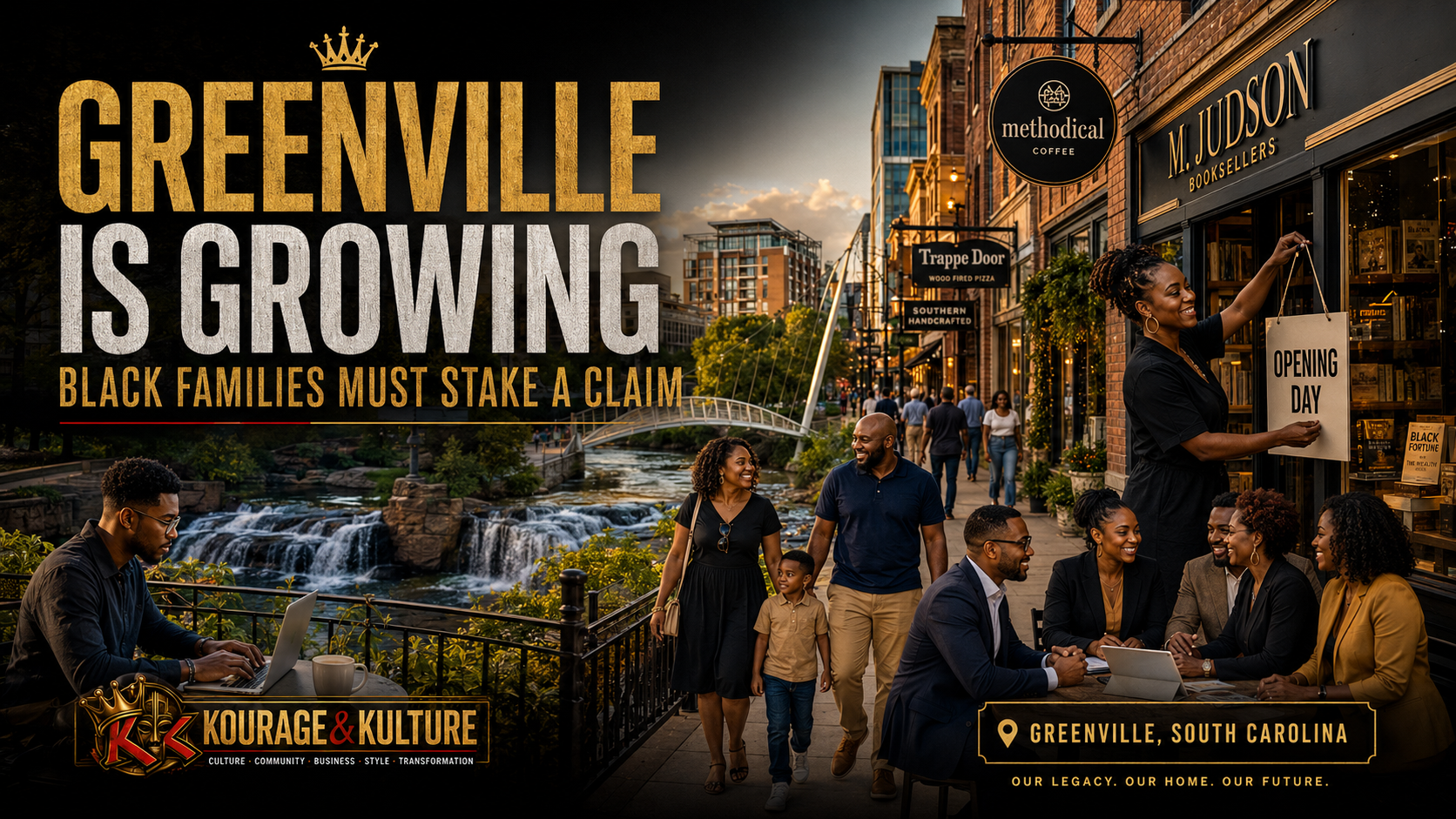
Greenville is growing, and growth always creates a question: who will benefit from it?
For Kourage & Kulture, this question is not abstract. It is personal, local, and urgent. Greenville is not just a city on a map. It is the ground where this platform is being built. It is the place where families work, businesses open, children grow, entrepreneurs take risks, and communities decide whether they will be spectators or builders.
According to U.S. Census QuickFacts, Greenville County was estimated at 583,125 people on July 1, 2025. That represents an 11.0% increase from the April 2020 estimate base. The same data lists Black residents as 16.8% of the county population.
That means the Black community is not outside Greenville’s future. It is part of the future. The issue is whether that future will include ownership, decision-making, business visibility, and legacy-building, or whether Black families will mostly participate as consumers inside a growing market.
Kourage & Kulture’s position is clear: Black families must stake a claim.
To stake a claim does not mean asking for permission. It means preparing. It means learning how money moves. It means supporting local businesses. It means creating businesses. It means becoming visible. It means using media, storytelling, sponsorship, and community relationships to help builders be seen.
Greenville’s financial landscape shows why this matters. Census QuickFacts reports median household income in Greenville County at $76,932 for 2020-2024, with per capita income at $43,319. Total retail sales in 2022 were listed at $11.84 billion, and retail sales per capita were $21,609. Accommodation and food services sales reached about $2.03 billion, and health care and social assistance receipts/revenue reached about $4.74 billion.
These numbers tell a story.
Money is moving through Greenville.
People are buying food, paying for services, receiving care, shopping, working, renting, building, and investing. The question is how much of that money is helping build local ownership, especially Black ownership.
If families are only consuming, they are participating in the economy at the lowest level. Consumption alone does not build control. It does not build assets. It does not create jobs for the next generation. It does not automatically create community power.
Ownership changes the conversation.
When a family owns a business, the children see possibility differently. When a community supports that business, money circulates with intention. When media highlights that business, the story becomes visible. When sponsors support platforms that promote local builders, the ecosystem becomes stronger.
This is why Kourage & Kulture’s third law matters:
Support the Business.
Supporting the business is not just a slogan. It is a strategy. It means buying from local businesses when possible. It means sharing their posts. It means writing reviews. It means connecting them to customers. It means sponsoring community media. It means treating entrepreneurs as builders, not just vendors.
Greenville County also had 15,493 employer establishments in 2023 and 53,013 nonemployer establishments. That nonemployer number matters because many people begin as one-person businesses, freelancers, contractors, side hustlers, creators, barbers, bakers, drivers, designers, consultants, cleaners, stylists, trainers, and service providers.
A side hustle can become a business. A business can become an employer. An employer can become a community anchor. A community anchor can become part of a family legacy.
But that only happens when people are taught to think beyond survival.
Black families need financial intelligence at home. Children should hear conversations about budgeting, saving, credit, insurance, business formation, taxes, invoices, marketing, ownership, and assets. Teenagers should know the difference between income and equity. Adults should understand that a business cannot grow on talent alone. It needs discipline, records, customer service, legal structure, branding, and follow-up.
This is where Kourage & Kulture becomes more than a magazine.
K&K is a platform for visibility. It is a place where businesses can be spotlighted, family growth can be discussed, financial literacy can be taught, and community progress can be documented. It is a media bridge between culture and ownership.
Greenville’s growth must include Black families as builders.
That means Black families must build businesses.
Black families must support businesses.
Black families must teach money at home.
Black families must protect their stories.
Black families must use media to create visibility.
Black families must prepare young people to become owners, not just workers and consumers.
This is not about separating from Greenville. It is about participating in Greenville with power.
A growing city needs strong families. Strong families need economic strategy. Economic strategy needs ownership. Ownership needs visibility. Visibility needs media. Media needs sponsors, subscribers, readers, writers, and community belief.
That is why Kourage & Kulture exists.
We stand on the 4 Laws:
Tell the Truth.
Respect the Builder.
Support the Business.
Protect the Legacy.
The truth is that Greenville is growing.
The builder is the entrepreneur, parent, worker, returning citizen, creator, sponsor, and young person choosing discipline.
The business must be supported because ownership creates family strength.
The legacy must be protected because growth without ownership can leave people behind.
Greenville’s future is being shaped right now.
Kourage & Kulture believes Black families must not stand outside that future.
We must stake a claim.
The 4 Laws of Kourage & Kulture
Tell the Truth.
Respect the Builder.
Support the Business.
Protect the Legacy.
Enjoyed this article?
Join the Kourage & Kulture Community for exclusive stories, business insights, wealth-building strategies, and community updates.
Want your business featured in Kourage & Kulture?
Become a Founding Sponsor and support culture, ownership, entrepreneurship, and community impact.