
How Love for the People Became a Revolutionary Strategy
Kourage & Kulture Monthly — August 2026 Issue
Theme: Black August: Warriors, Legacy & Liberation
4 Law Focus: Respect the Builder
Fred Hampton understood that revolutionary leadership was not measured by how loudly a person spoke, but by how effectively they educated, organized, fed, protected, and united the people.
The Legacy That Organized a Generation
Black August is a season of remembrance, discipline, sacrifice, and purpose. Among the names that continue to shape its legacy, few represent organized leadership more completely than Fred Hampton.
At just twenty-one years old, Hampton had become one of the most influential leaders of the Illinois Chapter of the Black Panther Party. His gift was not simply his ability to speak—it was his ability to organize. He inspired people to move beyond frustration and toward disciplined action, community service, political education, and institution-building.
Fred Hampton believed that real leadership required serving the people. He understood that lasting change was built through organized communities, educated youth, strong families, and institutions that met people’s everyday needs.
His life reminds us that courage is measured not only by resistance, but also by the willingness to build something that can outlive us.
Today, as Black communities continue to pursue ownership, education, economic opportunity, and self-determination, Hampton’s example remains a blueprint for leadership rooted in service, discipline, and collective responsibility.
Who Was Fred Hampton?
Fred Hampton was born on August 30, 1948, in Summit, Illinois, and grew up in nearby Maywood. From an early age, he demonstrated leadership, discipline, and a deep concern for his community. While still a teenager, he became active in the NAACP Youth Council, where he organized young people, advocated for better educational opportunities, and worked to improve conditions in his neighborhood.
Hampton possessed an uncommon ability to connect with people from different backgrounds while remaining firmly committed to advancing Black communities. His leadership was rooted in careful study, disciplined organizing, and the belief that ordinary people could build extraordinary institutions when they worked together.
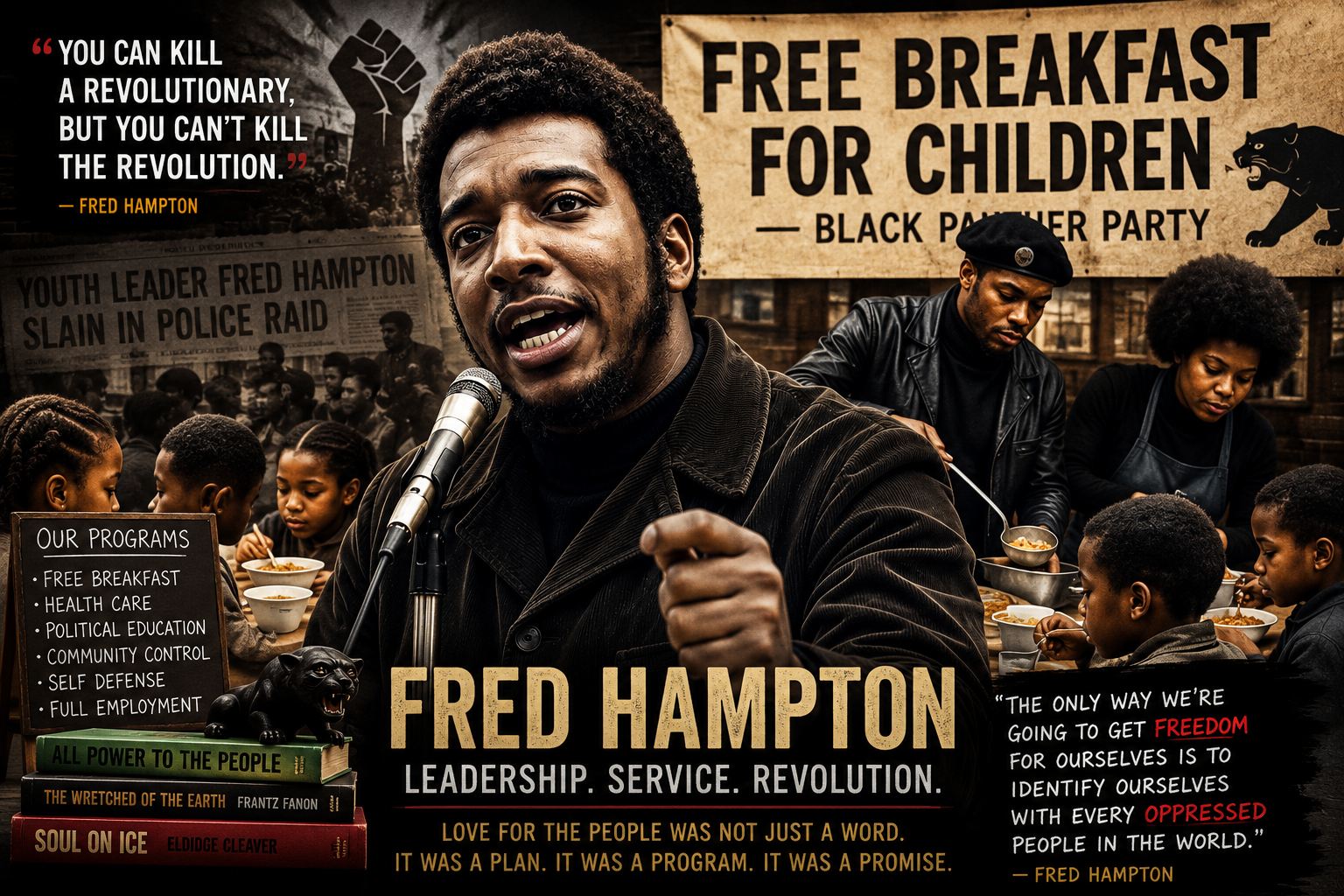
In 1968, Hampton joined the Illinois Chapter of the Black Panther Party and quickly emerged as one of its most dynamic leaders. Rather than relying on speeches alone, he helped organize community programs that addressed practical needs—food, education, healthcare, and political awareness. He believed these efforts strengthened communities while developing future leaders.
Although his life was brief, Hampton’s influence reached far beyond Chicago. His vision challenged people to think beyond individual success and toward collective responsibility. He encouraged communities to organize, educate themselves, and build institutions capable of serving future generations.
His legacy continues to remind us that leadership is not defined by position or age, but by the willingness to serve, organize, and leave a foundation others can continue to build upon.
Leadership Through Service
Fred Hampton believed that true leadership began with meeting the everyday needs of the people. While many viewed the Black Panther Party only through the lens of confrontation, Hampton devoted much of his energy to building programs that strengthened families, educated young people, and addressed immediate community needs.
One of the best-known efforts was the Free Breakfast for Children Program. Before many children began their school day, volunteers prepared and served nutritious meals so students could learn without the distraction of hunger. Hampton understood that education and opportunity were difficult to achieve when basic needs were unmet.
His work also supported community health initiatives, political education classes, clothing drives, and neighborhood organizing. These programs encouraged people to study history, understand their rights, develop practical skills, and become active participants in improving their own communities.
For Hampton, service was not charity—it was empowerment. Every breakfast served, every book studied, and every community meeting held was an investment in people. He believed strong communities were built by informed citizens who cared for one another and accepted responsibility for the future they wanted to create.
This philosophy continues to resonate today. Communities still benefit when neighbors mentor youth, support local businesses, strengthen schools, volunteer their time, and work together to solve shared challenges. Hampton’s example reminds us that lasting leadership is measured not only by words, but by consistent service that creates opportunity for others.
Building Unity Through Organization
Fred Hampton believed that lasting change required disciplined organization and a shared commitment to improving people’s lives. He encouraged individuals from different neighborhoods and backgrounds to work together around common challenges such as poverty, education, housing, healthcare, and economic opportunity.
While remaining firmly committed to advancing Black communities, Hampton also recognized that cooperation around shared material needs could strengthen broader efforts for justice. His approach emphasized unity without abandoning identity, purpose, or principle.
He challenged young people to become students of history rather than spectators. Political education, reading, critical thinking, and disciplined organizing were essential parts of his leadership philosophy. Hampton believed that informed communities were more difficult to divide and better equipped to build institutions that could serve future generations.
His example reminds us that strong communities are not built by personalities alone. They are built by teachers, parents, business owners, organizers, faith leaders, artists, and young people who accept responsibility for one another.
For Kourage & Kulture, this lesson remains timeless. The future of Black advancement depends not only on remembering great leaders, but on developing new leaders who can educate, build businesses, strengthen families, mentor youth, and leave lasting institutions for generations to come.
Building Unity Through Organization
Fred Hampton understood that movements are not sustained by emotion alone. They are sustained by disciplined people who are willing to study, organize, build institutions, and serve their communities with consistency. He believed leadership was measured not by popularity or titles, but by the ability to develop other leaders who could continue the work long after one person was gone.
His vision centered on meeting the practical needs of everyday people. Community programs, political education, youth development, food security, healthcare access, and neighborhood organization were not separate from the struggle for justice—they were the struggle. Hampton believed that a community capable of feeding its children, educating its youth, supporting its businesses, and protecting its elders was building the foundation for lasting freedom.
Although deeply committed to Black liberation, Hampton also recognized the importance of principled cooperation among communities facing similar economic and social challenges. He encouraged alliances rooted in mutual respect and shared purpose while remaining unwavering in his commitment to the advancement, dignity, and self-determination of Black people.
Education stood at the center of his philosophy. Hampton challenged young people to read deeply, question boldly, understand history, and develop the discipline necessary to become builders rather than spectators. He believed that knowledge without action produced little change, but knowledge joined with organization could transform entire communities.
That lesson remains urgent today. Every successful Black business, every classroom that inspires excellence, every mentor who guides a young person, every family strengthened, every community institution preserved, and every act of economic cooperation continues the work of building power where it is needed most.
At Kourage & Kulture, we believe Fred Hampton’s greatest legacy was not simply what he said—it was the blueprint he left behind. Leadership is service. Organization is power. Education is liberation. Strong families build strong communities. Strong communities build lasting institutions. And lasting institutions protect the future of a people.
“Respect the Builder.” Every generation inherits a foundation. Our responsibility is not merely to admire it—but to strengthen it for those who will come after us.
Why His Leadership Was Considered a Threat
By 1969, Fred Hampton had become one of the most influential young organizers in Chicago. His speeches inspired audiences, but it was his ability to transform ideas into organized action that drew widespread attention.
Hampton helped expand community programs, developed new leaders, encouraged political education, and organized efforts that brought people together around practical needs. His work demonstrated that disciplined organization could produce tangible results in neighborhoods facing significant economic and social challenges.
During this period, federal, state, and local law enforcement agencies were conducting extensive surveillance of several political organizations, including the Black Panther Party. Historical records released over the years, including documents related to the FBI’s COINTELPRO program, show that officials viewed certain political movements as potential threats to public order and national security. Those records continue to be studied and debated by historians, legal scholars, and civil rights researchers.
Before dawn on December 4, 1969, law enforcement officers entered the apartment where Hampton was sleeping. During the raid, Fred Hampton and fellow Black Panther Mark Clark were killed.
The raid, the investigation that followed, and the legal proceedings surrounding the case have remained subjects of historical research, public discussion, and legal examination for decades. Numerous books, court records, investigative reports, and scholarly works continue to analyze the events and their significance within the broader history of civil rights, policing, and political activism in the United States.
Fred Hampton was only twenty-one years old.
His life ended early, but the questions raised by his work, his leadership, and his death continue to shape conversations about justice, constitutional rights, community organizing, and public accountability.
History remembers leaders for many reasons.
Fred Hampton is remembered because he challenged a generation to believe that organized communities could build institutions capable of changing lives.
That belief remains one of his most enduring legacies.
“You can silence a voice, but it is far more difficult to silence an idea whose time has come.”
Why This Matters Today
Fred Hampton’s legacy is not confined to one city or one era. His emphasis on education, disciplined leadership, community service, and institution-building continues to offer lessons for communities seeking sustainable progress. While circumstances evolve over time, the principles of preparing future leaders, strengthening families, investing in young people, and building lasting institutions remain as relevant today as they were decades ago.
The Blueprint That Still Lives
History often celebrates those who dared to imagine a better future. Fred Hampton dared to do something even more demanding—he worked to build one.
His legacy reminds us that meaningful change does not begin with a single speech or a single moment of protest. It begins when people choose to educate themselves, strengthen their families, support local businesses, mentor young people, create opportunities, and build institutions that will outlive them. Lasting progress is measured not only by what a generation demands, but by what it leaves behind.
The challenges facing many communities today are different in form but familiar in substance. Educational disparities, economic inequality, housing insecurity, violence, and limited access to opportunity continue to affect countless families. These realities call for more than frustration—they call for disciplined leadership, informed citizenship, and sustained community investment.
Fred Hampton understood that the greatest measure of leadership was the ability to prepare others to lead. Every teacher who inspires excellence, every entrepreneur who creates jobs, every parent who instills values, every mentor who invests in a young life, and every neighbor who chooses service over indifference carries forward that same principle.
For Kourage & Kulture, Black August is more than a month of remembrance. It is a season of responsibility. We honor those who came before us not by placing their names only in history books, but by continuing the work they believed was possible. Their courage becomes meaningful when it inspires our own. Their sacrifices gain lasting purpose when they encourage us to build stronger communities, stronger institutions, and stronger generations.
The blueprint has already been drawn.
The question is whether we have the discipline, vision, and commitment to continue building.
“Legacies are not preserved by memory alone. They are preserved by builders who refuse to let vision die. Every generation receives an unfinished blueprint. The measure of our time is whether we leave the foundation stronger than we found it.”
Continue Your Study
Readers who wish to explore Fred Hampton’s life and legacy further may find these resources valuable:
Books
- The Assassination of Fred Hampton: How the FBI and the Chicago Police Murdered a Black Panther — Jeffrey Haas
- Black Against Empire: The History and Politics of the Black Panther Party — Joshua Bloom & Waldo E. Martin Jr.
Documentary
- The Murder of Fred Hampton (1971)
Feature Film
- Judas and the Black Messiah (2021)
“History remembers names. Nations remember builders. Every generation inherits unfinished work. The measure of our legacy is whether we leave stronger institutions, stronger families, and stronger communities than those we inherited.”
— Kourage & Kulture Editorial Board
The Four Laws of Kourage & Kulture
Tell the Truth.
Respect the Builder.
Support the Business.
Protect the Legacy.
From the Editorial Desk
Every generation inherits more than history—it inherits responsibility.
Some inherit wealth.
Some inherit struggle.
All inherit unfinished work.
The purpose of Kourage & Kulture is not simply to remember remarkable people. It is to challenge remarkable people who are still alive.
If this article ends when you finish reading it, then it has accomplished very little.
If it inspires you to mentor one child, support one Black-owned business, strengthen one family, build one institution, or preserve one piece of our history… then Fred Hampton’s blueprint continues to live.
That is how legacies survive.
That is how nations are built.
— Kourage & Kulture Editorial Desk
Continue the Conversation
If this story challenged your thinking, inspired your leadership, or encouraged you to learn more, share it with someone committed to building stronger communities.
Support independent Black media by reading, sharing, and investing in publications that preserve our stories and document our future.
Kourage & Kulture
“Truth. Culture. Legacy.”