
EDUCATION BEFORE THE CLASSROOM
Before education became associated with desks, bells, standardized tests, and diplomas, human beings were learning how to understand and shape their world.
FOUR LAW FOCUS: TELL THE TRUTH
Across Africa, societies developed and transmitted knowledge in agriculture, mathematics, metalworking, architecture, medicine, trade, governance, language, philosophy, religion, and the arts. Knowledge moved through families, communities, apprenticeships, oral traditions, written traditions, and centers of scholarship.
For Black people, this matters.
Our educational story does not begin with enslavement.
Enslavement profoundly disrupted African lives, families, cultures, and systems of knowledge. In the United States, enslaved people were also denied educational opportunities, and several Southern states enacted laws restricting the teaching of enslaved people to read and write.
Yet the desire for knowledge survived.
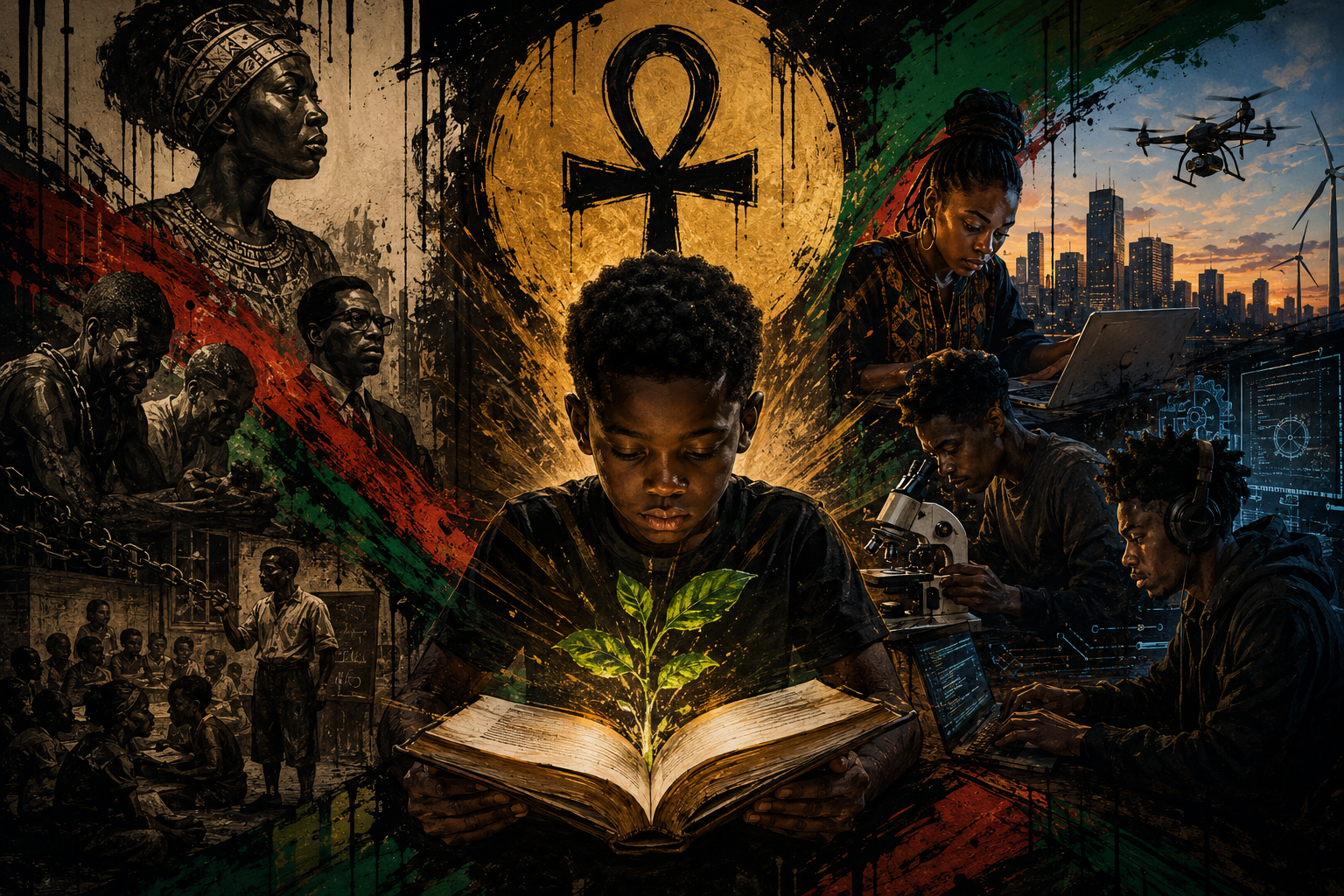
Black people learned despite tremendous barriers. After emancipation, freedpeople pursued education with extraordinary determination—establishing schools, supporting teachers, creating institutions, and building communities around the belief that literacy and knowledge could help secure freedom.
That history leaves us with a responsibility.
Education is not simply preparation for employment.
It is preparation for life.
To know our history.
To understand the present.
To question information.
To master useful skills.
To create.
To build.
To own.
And ultimately, to prepare the next generation to travel farther than we did.
That is education as liberation.
WHEN LEARNING BECAME AN ACT OF RESISTANCE
For generations in America, Black people understood something powerful:
If knowledge did not matter, nobody would have worked so hard to restrict our access to it.
Under slavery, educational opportunities for enslaved Black people were severely restricted, and several Southern states enacted laws designed to prevent enslaved people from learning to read and write.
Yet Black people pursued knowledge anyway.
Some learned secretly. Some learned from other Black people. Some found opportunities wherever they could. Literacy became more than the ability to recognize words—it could expand a person’s ability to communicate, understand the world around them, and imagine freedom beyond bondage.
After emancipation, that hunger for knowledge became visible across the nation.
From Maryland to Georgia, Virginia to Mississippi, Tennessee to Louisiana and throughout the former slaveholding states, freedpeople established and supported schools, transformed churches into classrooms, pursued literacy as adults, educated their children, and demanded access to public education.
Black Americans were not simply recipients of somebody else’s educational mission.
We were builders of our own educational future.
During Reconstruction, Black citizens became teachers, organizers, voters, legislators, ministers, institution-builders, and advocates for public education. Schools and colleges emerged that would help educate generations of Black teachers, professionals, thinkers, entrepreneurs, artists, scientists, and leaders.
Our ancestors understood that emancipation alone could not complete the work of freedom.
Freedom required knowledge.
Knowledge to read.
Knowledge to understand agreements.
Knowledge to participate in government.
Knowledge to recognize exploitation.
Knowledge to build businesses and institutions.
Knowledge to preserve our history.
Knowledge to teach the next generation.
That is why the Black struggle for education belongs at the center of the Black freedom story.
When access to knowledge is restricted, learning becomes resistance. When knowledge is gained, organized, protected, and passed forward, learning becomes power.
BUILDING OUR OWN INSTITUTIONS
Freedom presented Black people with a question:
What will we build with it?
Our ancestors answered with action.
Across Black communities, education became institution-building. Churches became classrooms. Communities raised money, secured buildings, supported teachers, organized schools, and created spaces where children and adults could learn.
Black teachers became essential carriers of knowledge. In many communities, literate Black men and women taught relatives, neighbors, children, and adults. Their names were not always preserved in the historical record, but their work helped educate a people emerging from generations of bondage.
And the work extended beyond individual classrooms.
Black churches became centers of education, organization, political participation, mutual support, and community life.
Black citizens also used political participation during Reconstruction to push for public education and greater educational access.
But our work did not stop with public schools.
Black communities helped establish colleges, academies, training schools, newspapers, libraries, literary societies, and other institutions through which knowledge could be developed, protected, and passed forward.
Our educational infrastructure was bigger than any single school or college.
The Black classroom was wherever knowledge could be gathered and passed forward.
A church.
A schoolhouse.
A kitchen table.
A newspaper.
A library.
A community meeting.
A teacher standing before children.
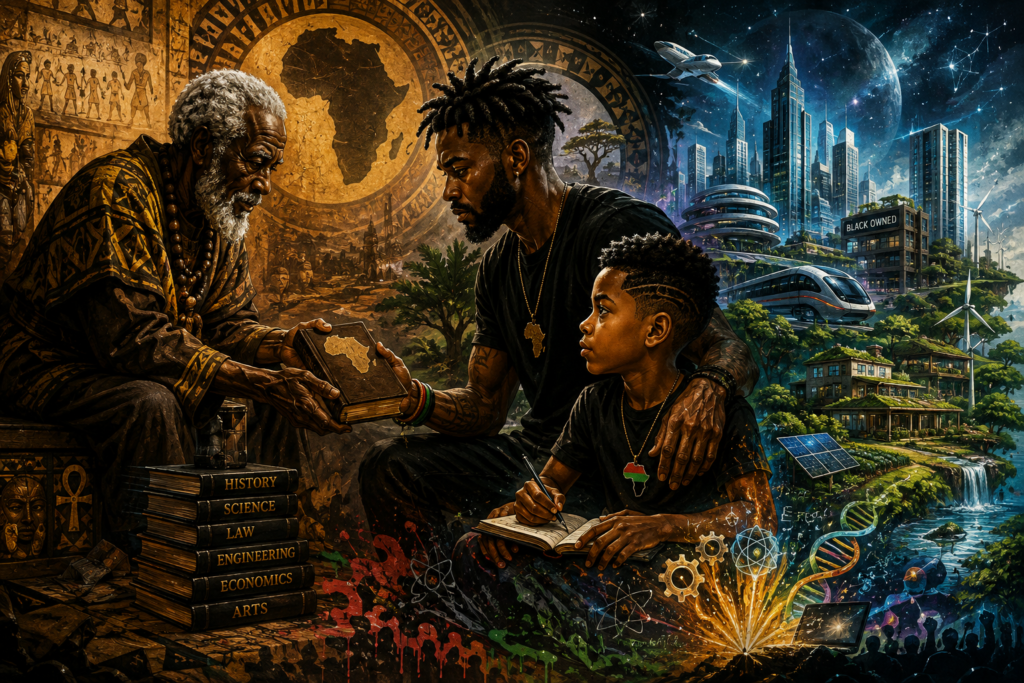
An elder teaching history.
A skilled worker teaching a trade.
A parent teaching a child to read.
Institution-building means more than constructing buildings. It means creating systems capable of carrying knowledge from one generation to the next.
That is one of the great lessons of our educational history:
When the doors were closed, we created doors.
When classrooms were denied, we created classrooms.
When knowledge was restricted, we found ways to teach.
And when institutions were needed, Black people became institution builders.
WHO CONTROLS THE EDUCATION?
Getting access to a classroom was never the end of the struggle.
There is another question:
Who decides what is taught once we enter it?
Education can give a person the tools to investigate ideas, examine evidence, question assumptions, understand different perspectives, and reach informed conclusions.
But when learning demands acceptance without examination—when questions are discouraged, history is distorted, or important perspectives are deliberately excluded—we move away from education and toward indoctrination.
Real education should strengthen the mind, not surrender it.
For Black people, this question carries historical weight.
For generations, Black scholars and educators challenged versions of history that marginalized, distorted, or omitted Black experiences and achievements.
Carter G. Woodson confronted this problem directly. He argued that education disconnected from a people’s history and circumstances could fail to prepare them to understand themselves or improve their communities.
That struggle continues to give us an important principle:
We should never fear examining what we have been taught.
Education should invite evidence.
Education should invite questions.
Education should invite comparison.
Education should invite investigation.
Because knowledge that can withstand examination becomes stronger—not weaker.
THE DIFFERENCE BETWEEN EDUCATION AND INDOCTRINATION
Education and indoctrination are not the same thing.
Education teaches you how to think.
Indoctrination tells you what to think.
Education presents evidence and encourages examination.
Indoctrination presents conclusions and discourages challenge.
Education exposes the learner to competing ideas.
Indoctrination protects one idea from competition.
Education welcomes questions.
Indoctrination fears them.
Education develops independent minds.
Indoctrination produces obedient ones.
WHO WRITES THE CURRICULUM?
Every curriculum makes choices.
Someone decides which civilizations are studied.
Someone decides which thinkers are considered important.
Someone decides which books become required reading.
Someone decides which historical events receive a chapter—and which receive a paragraph.
Someone decides whose achievements are remembered and whose are forgotten.
That does not automatically make a curriculum dishonest. But it means we must learn to ask a serious question:
Who selected the knowledge we are being taught—and what knowledge was left outside the classroom?
A complete education should not fear that question.
It should demand it.
RECLAIMING THE BLACK INTELLECTUAL TRADITION
Black intellectual history did not begin when somebody allowed us into a university.
Long before modern American classrooms, African societies produced systems of knowledge in mathematics, astronomy, medicine, architecture, agriculture, philosophy, spirituality, governance, language, and the arts.
Across generations in America and throughout the African diaspora, Black thinkers continued that tradition.
Frederick Douglass understood literacy as a pathway toward freedom.
Anna Julia Cooper argued for the intellectual development and education of Black women.
Carter G. Woodson challenged an educational system that could teach Black people while disconnecting them from their own history.
W.E.B. Du Bois fought for rigorous intellectual development and the cultivation of Black leadership.
Later generations expanded the conversation through thinkers such as John Henrik Clarke, Dr. Cheikh Anta Diop, Dr. Chancellor Williams, Dr. Yosef Ben-Jochannan, and Dr. Asa G. Hilliard III.
They did not agree on everything—and they should not be treated as if they did.
That is precisely the point.
A serious intellectual tradition is not built by repeating one voice. It is built by studying, questioning, comparing evidence, debating ideas, correcting errors, and carrying knowledge forward.
We do not honor our thinkers by turning them into untouchable icons.
We honor them by becoming thinkers ourselves.
WHAT MUST WE TEACH THE NEXT GENERATION?
The next generation needs more than information.
They need the ability to turn knowledge into power, protection, creation, and ownership.
Our children must learn to read deeply, write clearly, calculate accurately, communicate effectively, examine evidence, solve problems, and think critically.
But their education cannot end there.
They must know their history—not simply the history of what was done to Black people, but the history of what Black people created, discovered, defended, built, organized, preserved, and transformed.
They must understand the African foundations of their story, the Black experience in America, and the continuing story of the African diaspora.
A child who knows struggle but never learns achievement has received an incomplete history.
History gives us roots.
But roots must produce fruit.
The next generation must understand money—not simply how to earn it, but how to budget it, protect it, invest it, multiply it, and use it to create ownership.
They must understand business.
They must understand credit.
They must understand contracts.
They must understand property and real estate.
They must understand taxes.
They must understand skilled trades.
They must understand technology, artificial intelligence, cybersecurity, coding, engineering, science, and the digital economy.
They must understand law well enough to recognize their rights, responsibilities, agreements, and obligations.
And they must understand media—because whoever can influence what people see, hear, believe, desire, and discuss possesses enormous power.
We cannot prepare our children only to enter somebody else’s economy.
We must prepare them to build within it, compete within it, own within it—and create beyond it.
EDUCATION DOESN’T STOP AT SCHOOL
A school can teach a child.
A community can educate a generation.
Education happens wherever knowledge, discipline, skill, culture, and experience are intentionally passed forward.
Parents are educators.
Grandparents and elders are educators.
Writers and journalists are educators.
Artists and musicians are educators.
Entrepreneurs are educators.
Carpenters, electricians, mechanics, barbers, builders, farmers, engineers, programmers, and craftspeople are educators when they pass their knowledge forward.
Every person who possesses a useful skill possesses something that can strengthen the next generation.
This means we cannot place the entire responsibility for our children’s development on a school system.
The home must teach.
The community must teach.
Our institutions must teach.
Our media must teach.
And those who have learned must return and teach somebody else.
Knowledge becomes legacy when it survives the person who learned it.
MEDIA IS A CLASSROOM TOO
Education does not only happen through textbooks.
Every day, people are being taught by screens.
News teaches.
Music teaches.
Film teaches.
Social media teaches.
Podcasts teach.
Advertising teaches.
Even entertainment carries messages about identity, success, beauty, relationships, money, power, and what kind of future people should desire.
The question is not whether media educates.
The question is: What is it teaching us?
When a people do not participate in telling their own stories, interpreting their own experiences, documenting their communities, and preserving their own voices, somebody else gains enormous influence over how those people are understood.
That is why independent media matters.
We need journalists who investigate.
Photographers who document.
Writers who preserve.
Artists who imagine.
Filmmakers who reveal.
Publishers who provide platforms.
And communities willing to support institutions that tell their stories with seriousness and integrity.
Owning the means to tell our story is part of owning our intellectual future.
FROM EDUCATION TO LIBERATION
Education alone does not guarantee liberation.
Knowledge must become action.
What we learn must change how we think.
How we think must change how we move.
How we move must change what we build.
And what we build must create something the next generation can inherit.
That means education must produce more than credentials.
It should produce thinkers.
Builders.
Researchers.
Teachers.
Creators.
Skilled workers.
Entrepreneurs.
Scientists.
Engineers.
Journalists.
Institution-builders.
And people capable of questioning what they are told while having the discipline to investigate what is true.
The goal is not to tell our children what to think.
The goal is to develop minds powerful enough to think for themselves.
Study the past.
Master the present.
Build the future.
Then teach somebody else how you did it.
That is when education becomes more than information.
That is when education becomes liberation.
I do not believe our greatest problem is a lack of intelligence.
I believe too much of our intelligence has gone undeveloped, disconnected, and unorganized.
We have brilliant children.
We have skilled men and women.
We have elders carrying knowledge that cannot be replaced once they are gone.
We have creators, builders, thinkers, entrepreneurs, teachers, and visionaries in our communities.
The responsibility before us is to connect them.
Teach what you know. Learn what you do not. Question what you are told. Research what you question. Build what we need. And leave knowledge behind for those coming after us.
Kourage & Kulture will always have a place in that work.
Because our future cannot simply be something we wait for.
— Shabazz
Publisher, Kourage & Kulture