
TEACHING BLACK YOUTH TO BUILD WITH TECHNOLOGY
How coding, artificial intelligence, digital media and cybersecurity can turn the next generation from technology consumers into creators, producers and owners.
Written by Shabazz | Kourage & Kulture
LAW III — SUPPORT THE BUSINESS
Black youth are among the most powerful consumers of technology, music, gaming, social media and digital culture. The next move is ownership.
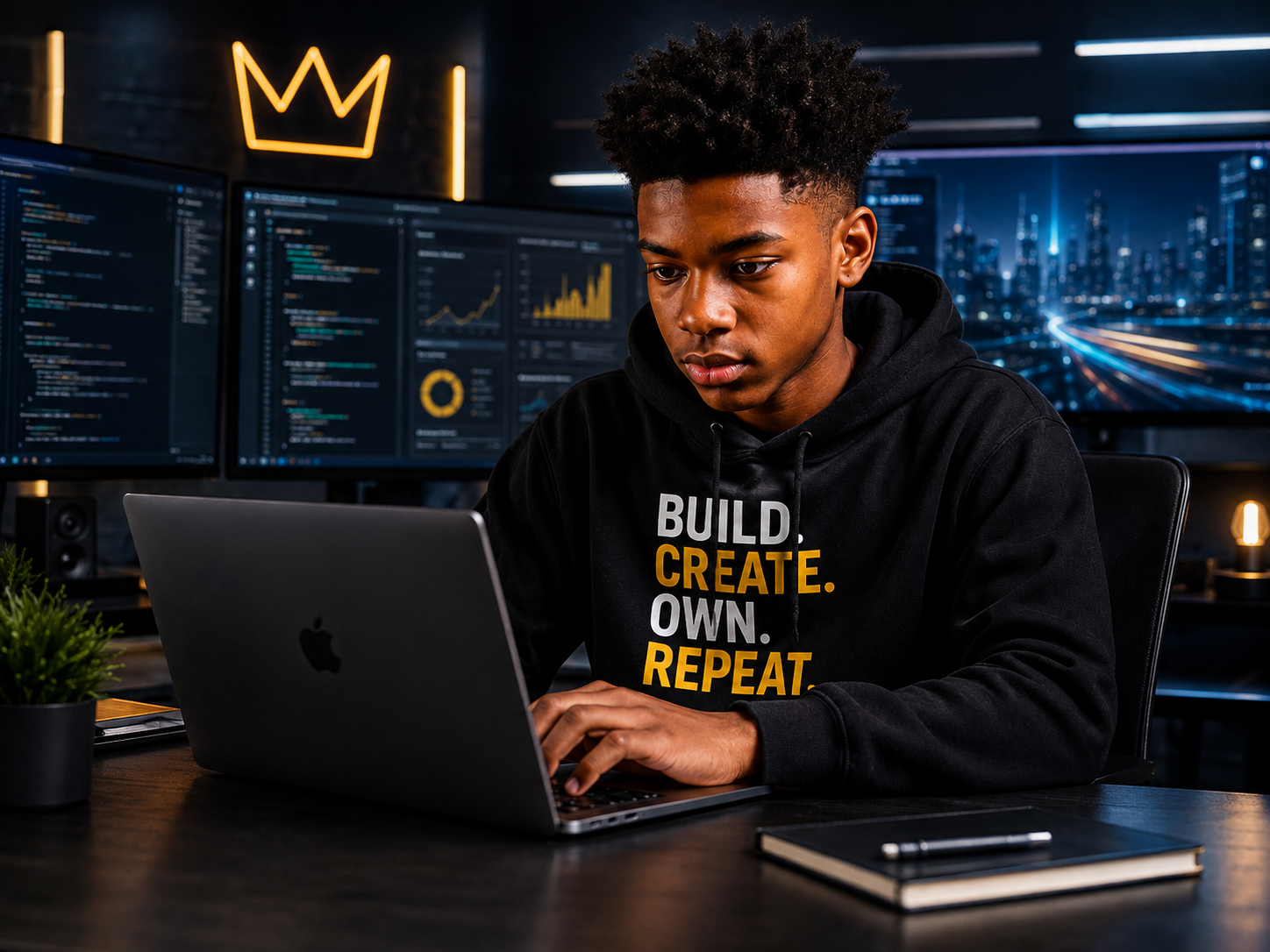
A phone can be more than entertainment. It can become a camera, editing suite, storefront, classroom and publishing company. A laptop can become a coding lab, design studio, cybersecurity workstation or business headquarters.
The question is no longer whether our children will use technology. The question is whether they will control what they create with it.
Real digital education must teach them how to code, build websites, edit video, use artificial intelligence, protect data, create intellectual property and turn skills into income.
The future will belong to people who understand how the technology works—not only how to scroll through it.
THE DEVICE IS NOT THE SKILL
Owning technology does not equal understanding it. The advantage comes from knowing how to make technology produce value.
Black youth should be learning:
- AI: research, automation, prompting and fact-checking.
- Coding: websites, apps and software logic.
- Cybersecurity: protecting accounts, businesses and digital assets.
- Video production: filming, editing and publishing.
- Digital design: graphics, branding and advertising.
- E-commerce: turning products and ideas into online businesses.
The goal is simple: leave childhood with a portfolio of skills, not just a history of screen time.
BUILD SOMETHING BEFORE YOU BUY SOMETHING
Digital ownership starts when young people create assets that can keep working after the screen is turned off.
A student who can build a website can serve local businesses. A young editor can produce videos for brands. A coder can create software. A designer can sell original graphics. A photographer can license images.
That is the shift: technology stops being an expense and starts becoming infrastructure.
Teach the next generation to ask one question every time they open a device:
What can I create, own or earn from this?
OWN THE WORK, NOT JUST THE MOMENT
Creation means little without ownership.
Black youth should learn early to protect what they build:
- Keep original files and source material.
- Use contracts before doing paid creative work.
- Understand copyrights, trademarks and licensing.
- Separate personal accounts from business accounts.
- Back up valuable work in more than one place.
- Never give away passwords, master files or ownership rights casually.
A viral moment can disappear in a day. Intellectual property can pay for years.
The lesson is bigger than “make content.”
Build assets. Protect them. Control them.
PROOF BEATS POTENTIAL
In the digital economy, saying “I know how” is weaker than showing what you built.
Every young creator should leave school with a digital portfolio containing real work:
- A functioning website
- Edited video
- Original graphic campaign
- Basic app or coding project
- Business or brand concept
- Professional email and résumé
- Links to completed projects
Grades can open a door. Proof of skill can create the door.
The objective is not simply employment.
It is leverage.
BUILD THE ECOSYSTEM
Talent without access gets wasted.
Families, schools, churches and community organizations can create a stronger technology pipeline by providing:
- Reliable laptops and internet access
- Coding and media labs
- Mentors already working in technology
- Paid internships and apprenticeships
- Competitions where youth build real products
- Local businesses willing to hire young creators
We do not need every child to become a programmer.
We need every child to understand that technology can be a tool of production, power and ownership.
THE NEXT CLASSROOM IS EVERYWHERE
The strongest advantage we can give Black youth is the ability to learn fast, adapt fast and build independently.
Technology changes. Platforms disappear. Algorithms shift.
But a young person who knows how to research, create, communicate, solve problems and protect ownership can keep moving.
That is the real education:
Not dependence on the next opportunity — the ability to create one.
LAW III — SUPPORT THE BUSINESS
When Black youth learn to create with technology, the next responsibility is to hire them, buy from them and invest in what they build.
A skill becomes economic power when a community creates a market around it.
Teach the skill. Fund the work. Circulate the opportunity. Own the result.
CLOSE THE GAP
The digital divide is no longer just about who has internet access.
It is about who understands the tools well enough to build with them.
Black youth cannot afford to enter the future only as users of platforms owned by somebody else.
They need the skills to create the platform, protect the idea, monetize the work and keep the ownership.
The future is coming either way. Our children should meet it as builders.