

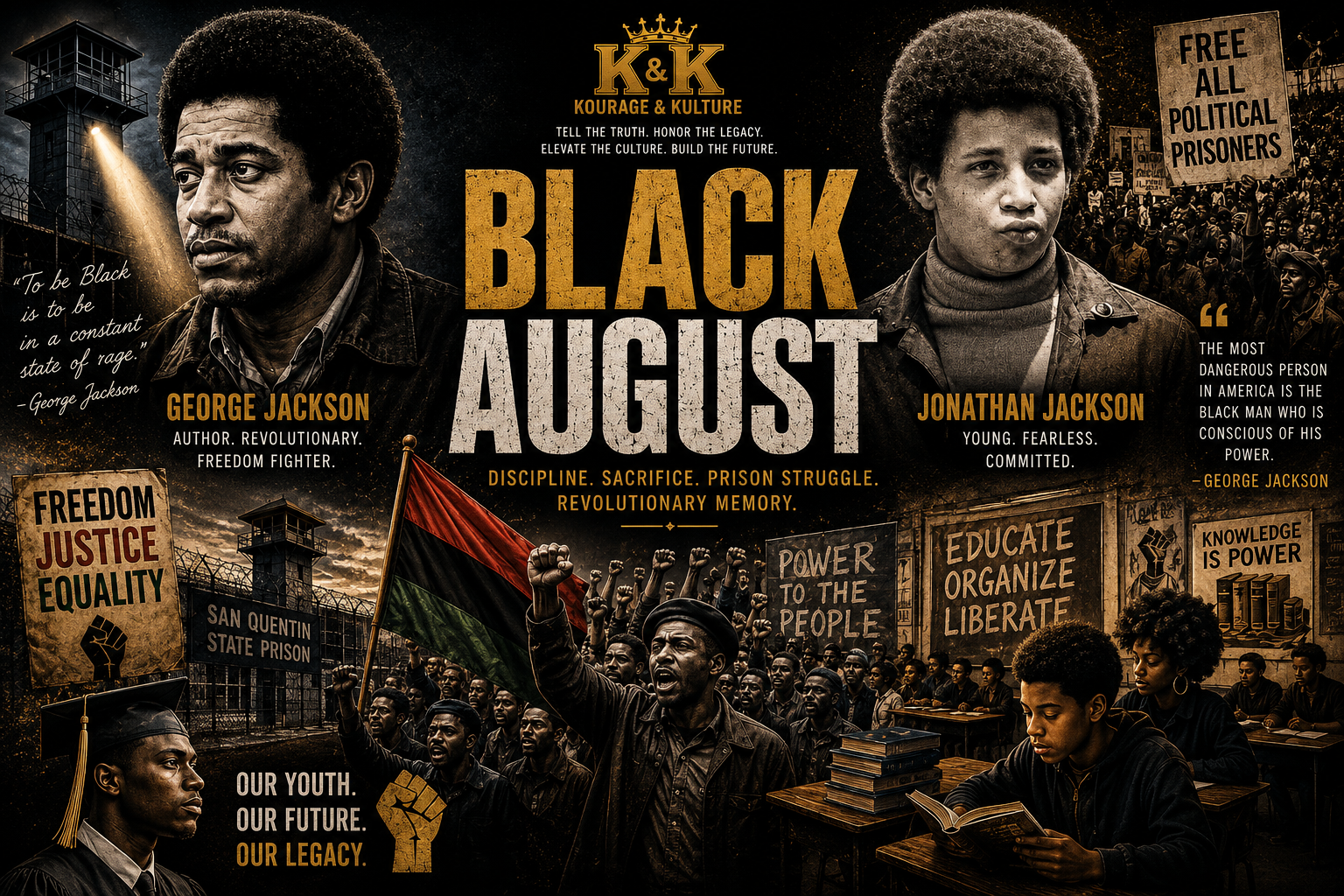
The Legacy That Still Calls a Generation to Courage
“Memory without discipline becomes nostalgia. Discipline turns memory into legacy.”
Theme: Black August: Warriors, Legacy & Liberation
4 Law Focus: Tell the Truth
Black August did not begin as a trend. It emerged from prison struggle, disciplined remembrance, political education, fasting, sacrifice, and the refusal to let Black revolutionary memory be erased.
The Month That Became a Discipline
August carries a particular weight in Black freedom history.
It holds the memory of uprisings, prison struggle, political education, sacrifice, and the people who refused to let confinement become silence. Black August grew from that tradition—not as a commercial theme, but as a disciplined practice of remembrance.
Its roots are closely connected to California prisons and to the lives of George Jackson, Jonathan Jackson, Khatari Gaulden, James McClain, William Christmas, and others whose names became part of a larger struggle over imprisonment, racism, state power, resistance, and revolutionary consciousness.
Over time, participants observed Black August through study, fasting, exercise, reflection, political education, and collective responsibility. The purpose was not simply to mourn the dead. It was to strengthen the living.
That distinction matters.
Black August asks more than whether we remember a name. It asks whether we understand the conditions that shaped that life, whether we study the writings left behind, and whether memory changes how we live, organize, and build.
Memory becomes meaningful when it produces discipline.
George Jackson: Reading Behind the Walls
George Jackson entered California’s prison system as a young man and remained confined for approximately a decade. During those years, he read intensely, studied political history and economics, and developed the ideas that would later make his prison correspondence internationally known.
Prison attempted to control his movement, schedule, relationships, and access to the outside world. Reading gave him another territory.
Through books, correspondence, and disciplined self-education, Jackson began examining racism, capitalism, colonialism, policing, incarceration, and revolutionary movements. His intellectual development did not erase the anger in his writing. It gave that anger structure, vocabulary, and historical direction.
His letters carried several voices at once. They could be personal, affectionate, severe, philosophical, contradictory, and politically uncompromising. He wrote to his parents, friends, supporters, attorneys, and fellow organizers while trying to explain both the conditions surrounding him and the transformation occurring within him.
Those letters were collected in Soledad Brother: The Prison Letters of George Jackson, published in 1970. The book combined autobiography, family correspondence, prison observation, and political analysis, bringing Jackson’s writing to readers far beyond California’s prison walls.
His later work, Blood in My Eye, was published after his death in 1972. It presented a more concentrated statement of his revolutionary political thought and reflected the urgency of the final period of his life.
Jackson’s writings should not be treated as scripture. They should be studied as primary documents produced by a complex man inside extreme conditions. His conclusions can be examined, challenged, placed in context, and compared with other evidence.
But the achievement cannot be dismissed.
A prison cell was designed to contain him.
Through disciplined reading and writing, he forced the world outside to confront his voice.
A prison cell confined his body. Study expanded the territory of his mind.
The Soledad Brothers: When One Case Became a National Conversation
The story of the Soledad Brothers became one of the defining legal and political controversies of the late 1960s and early 1970s.
George Jackson, Fleeta Drumgo, and John Clutchette were charged in connection with the death of a correctional officer following the killing of three Black prisoners by another officer at California’s Soledad Prison. Supporters argued that the charges reflected broader patterns of racial inequality within the criminal justice system, while prosecutors maintained that the evidence supported criminal prosecution.
As the case developed, it grew beyond a courtroom proceeding.
Civil rights leaders, students, attorneys, labor organizers, faith communities, artists, and activists across the United States followed the proceedings closely. Committees formed to raise legal defense funds, organize public education campaigns, and debate the fairness of the criminal justice system.
For many observers, the Soledad Brothers represented more than three defendants.
They became symbols within a larger national conversation about race, incarceration, policing, due process, prison conditions, and the unequal application of justice.
Whether viewed through a legal, historical, or political lens, the case helped draw unprecedented public attention to conditions inside American prisons and encouraged many people to examine institutions that had previously received little public scrutiny.
That conversation continues today.
Questions surrounding prison reform, sentencing, rehabilitation, accountability, public safety, and equal justice remain subjects of national debate, demonstrating that the issues raised during the Soledad era did not end with the courtroom proceedings themselves.
Kourage & Kulture Reflection
History asks us to study difficult cases carefully. Understanding a movement does not require agreement with every action or every conclusion. It requires a commitment to truth, context, and evidence.
Historical Timeline
- 1960 — George Jackson enters the California prison system.
- January 1970 — George Jackson, Fleeta Drumgo, and John Clutchette become known nationally as the Soledad Brothers.
- 1970 — Soledad Brother: The Prison Letters of George Jackson is published.
- August 7, 1970 — Jonathan Jackson attempts to free prisoners during the Marin County courthouse incident.
- August 21, 1971 — George Jackson is killed at San Quentin State Prison.
- 1979 — Black August traditions become organized as an annual period of remembrance, study, and discipline among incarcerated activists.
⚖️ Editorial Note
This feature reflects one of the guiding principles established in the Kourage & Kulture Constitution:
We tell the truth with context.
Our editorial standard is to present documented history carefully, distinguish verified facts from interpretation, acknowledge where historians and participants disagree, and encourage readers to continue studying primary sources.
We believe journalism should preserve the historical record with honesty, fairness, and intellectual discipline. That commitment strengthens both public understanding and the long-term credibility of Kourage & Kulture.
How Black August Was Born
Black August did not begin as a holiday.
It began as a disciplined tradition of remembrance among incarcerated Black revolutionaries in California during the late 1970s.
Participants chose the month of August because it carried profound historical meaning. It marked the deaths of George Jackson, Jonathan Jackson, William Christmas, James McClain, Khatari Gaulden, and remembered other significant moments of resistance that occurred during the month.
Rather than responding with despair, participants transformed remembrance into discipline.
Black August became a period devoted to study, physical training, reflection, political education, reading, writing, self-control, and community responsibility.
Many participants observed voluntary fasting, reduced entertainment, increased exercise, and daily study—not as rituals performed for public recognition, but as personal commitments to intellectual and moral growth.
The tradition eventually spread beyond prison walls.
Community organizations, educators, families, scholars, artists, and cultural institutions began recognizing Black August as an opportunity to examine Black history more deeply, support political education, strengthen communities, and preserve historical memory.
Today, Black August continues to evolve.
For some, it remains rooted in prison history and political struggle.
For others, it has expanded to include African history, economic empowerment, family leadership, education, entrepreneurship, health, and cultural preservation.
While practices differ from community to community, one principle remains remarkably consistent:
Black August asks us to become more disciplined than we were yesterday.
That may be its greatest legacy.
Black August is not simply about remembering history. It is about allowing history to transform the way we live today.
Knowledge without discipline fades. Discipline without purpose becomes routine. Black August reminds us to unite both.
The Legacy Lives On
George Jackson never lived to see Black August become an annual tradition.
Jonathan Jackson never reached adulthood.
Many of those whose lives shaped the movement never witnessed the generations that would continue studying their names, debating their ideas, preserving their writings, and remembering their sacrifices.
Yet their stories endure.
Not because history is frozen.
But because each generation chooses whether to remember.
Black August is ultimately not about creating heroes beyond criticism or reducing complex lives to simple slogans. It is about accepting the responsibility to study history honestly, preserve memory faithfully, and build stronger communities through knowledge, discipline, and purposeful action.
Every generation must decide what it will carry forward.
Will we preserve only names?
Or will we preserve the values that allowed people to endure extraordinary circumstances with courage, conviction, and commitment?
That question belongs to each of us.
Black August reminds us that freedom requires more than remembrance.
It requires preparation.
It requires discipline.
It requires responsibility.
And above all, it requires people willing to build a future worthy of those who came before us.
The greatest tribute we can offer history is not admiration.
It is action.
The greatest tribute we can offer history is not admiration. It is action.
K&K Final Reflection
History is not preserved by monuments alone.
It is preserved by people who read, teach, build, question, organize, create, mentor, and serve. Every generation inherits a story—but every generation also writes one.
As you leave this article, ask yourself:
- What history am I helping preserve?
- What discipline am I developing?
- What legacy will I leave for those who come after me?
The answers to those questions will shape far more than a single month.
They will help shape the future.
Tell the Truth.
Respect the Builder.
Support the Business.
Protect the Legacy.
— Kourage & Kulture
Why This Matters Today
Black August is not only about remembering the past. It challenges each generation to ask how it will preserve history, strengthen families, educate young people, support community institutions, and build something that lasts.
Continue Your Study
- Soledad Brother — George Jackson
- Blood in My Eye — George Jackson
- If They Come in the Morning — Angela Y. Davis
- The War Before — Safiya Bukhari
History does not ask to be admired from a distance. It asks to be studied, protected, and carried forward. The responsibility now belongs to us.