
Studying Uprising, Freedom & Historical Responsibility
Why This History Demands Serious Study
Resistance must be studied with seriousness, not consumed as spectacle.
August carries the memory of uprisings that exposed the violence beneath systems that called themselves civilized. These moments are not important because they are dramatic. They are important because they reveal what human beings will do when forced to live under domination.
To study resistance honestly, we must resist simplification. We must not turn rebellion into entertainment, nor should we turn oppression into abstract history. The goal is to understand what conditions produced revolt, what choices were made, what costs followed, and what lessons remain for us now.
Nat Turner and the Reality of Revolt
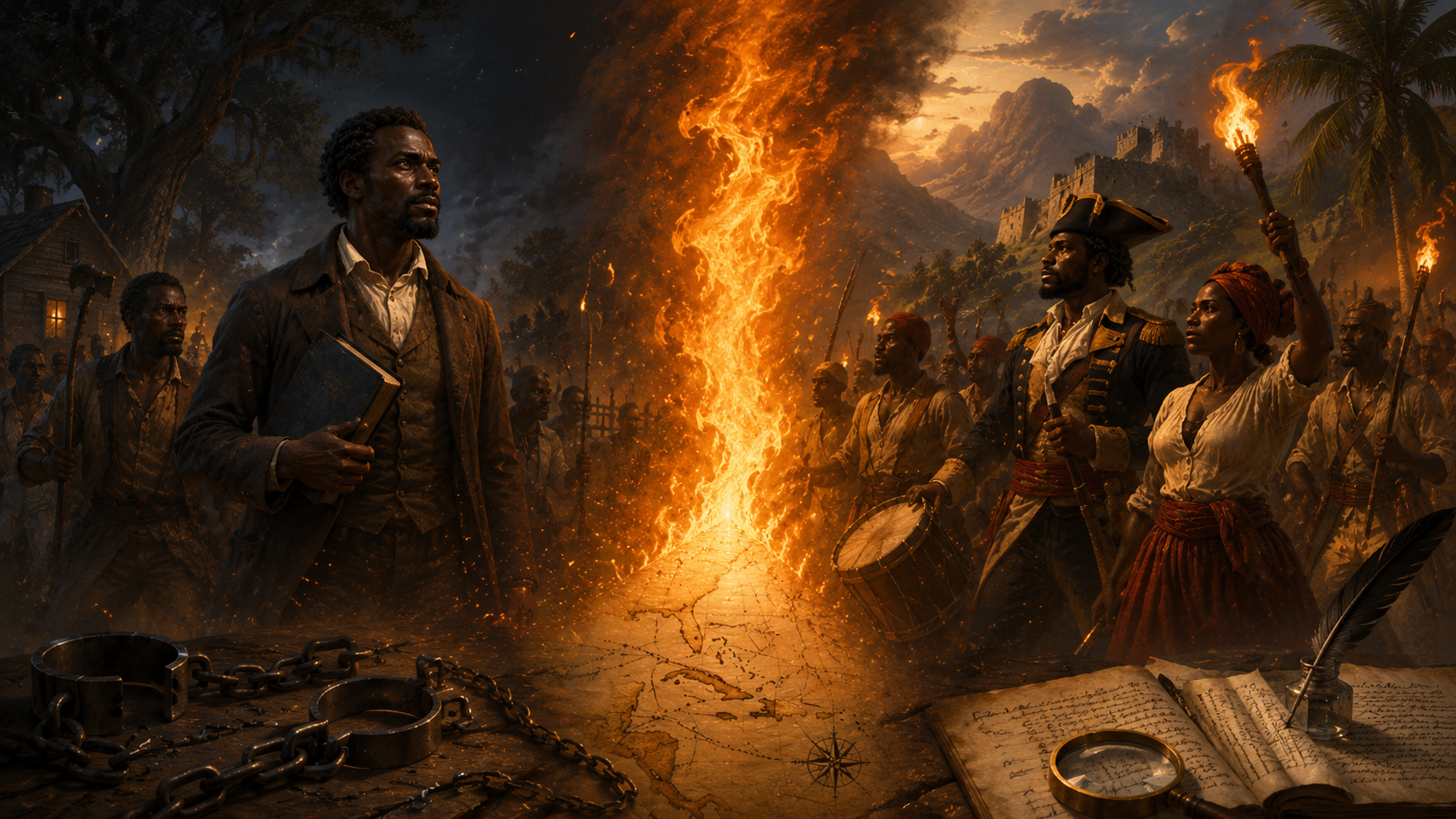
In August 1831, Nat Turner led an insurrection in Southampton County, Virginia. Turner was an enslaved preacher whose religious worldview and lived experience under slavery shaped his decision to rebel. The uprising killed white men, women, and children. Its suppression was followed by retaliatory violence against Black people, including many who had no involvement.
To study Nat Turner responsibly is to hold several truths at once. Slavery was a system of kidnapping, forced labor, sexual violence, punishment, family separation, and legal nonpersonhood. Enslaved people were not passive, and rebellion was one of the ways some chose to resist. At the same time, the revolt involved civilian deaths and terror. Serious history does not hide either reality.
The most famous account, The Confessions of Nat Turner, was mediated through white attorney Thomas R. Gray, and historians have long debated its reliability, voice, and editorial shaping. That makes source criticism essential. We should neither blindly accept every line nor dismiss Turner’s significance. We study carefully, question honestly, and refuse shallow conclusions.
Haiti Changed the Atlantic World
Four decades earlier, the Haitian Revolution had already transformed the Atlantic world. Enslaved and free people in Saint-Domingue launched a struggle that destroyed slavery in the colony and created independent Haiti in 1804.
Dutty Boukman, Cécile Fatiman, Toussaint Louverture, Jean-Jacques Dessalines, women combatants, laborers, soldiers, and maroons all belonged to a revolutionary process larger than any one individual. Haiti proved that enslaved people could defeat colonial armies and create a nation.
That victory terrified slaveholding societies and inspired Black people across the Atlantic. But Haiti’s story also includes complexity. Independence did not bring peace without pressure. The country faced foreign isolation, internal conflict, and a devastating indemnity later imposed by France. Freedom was won, but it was punished.
Nat Turner and Haiti Are Not the Same Story
Nat Turner and Haiti should not be forced into one simple story. One was a localized uprising suppressed within days. The other was a long revolution that produced national independence. One remained within the borders of enslavement. The other broke a colonial system and changed world history.
Still, both stories reveal something essential: enslaved people understood their condition, imagined freedom, and were willing to act. These were not passive people waiting to be saved by morality. They were human beings capable of analysis, courage, strategy, faith, anger, and action.
The Fire of Resistance Must Illuminate, Not Blind
The fire of resistance must illuminate, not blind.
The lesson is not violence for its own sake. The lesson is that systems built on domination create resistance. If oppression is violent, then rebellion does not come from nowhere. It emerges from pressure, dehumanization, and the refusal to remain broken.
But rebellion alone is not enough. A serious people must ask what comes after revolt. What institutions must be built? What protection must be created? What education, land, economy, and leadership must follow? Freedom cannot survive on emotion alone. It requires structure.
Why This Matters Now
These histories matter now because many people want the language of liberation without the discipline of study. They want symbols without context. They want heroes without contradiction. They want resistance without responsibility.
Black August calls for something deeper.
We are asked to remember the dead, honor the fighters, study the archives, and build stronger institutions in the present. The goal is not to romanticize bloodshed. The goal is to understand what domination produces and what disciplined freedom requires.
K&K Reflection
- How should history speak about resistance that includes civilian death?
- What must be built after a system is challenged or overthrown?
- Are we studying liberation as a slogan, or as a responsibility?