
Black History Before Enslavement
History Before Captivity
A people cannot build a complete identity if their history begins only with capture.
Too often, Black history is introduced through slavery, colonialism, segregation, imprisonment, and resistance. Those chapters must be studied honestly, but they are not the beginning of the story.
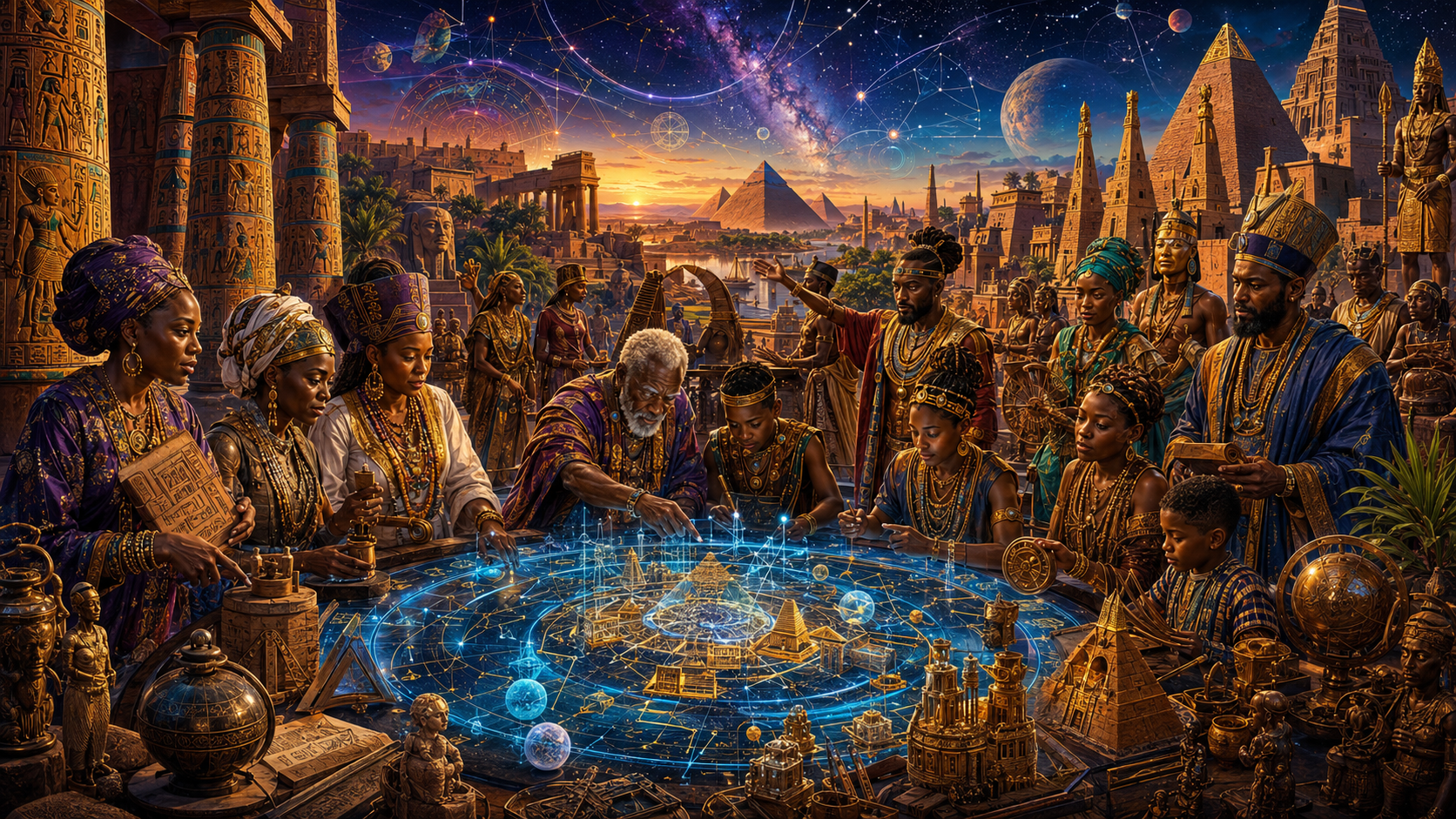
Long before European enslavement of African people in the Americas, the continent held cities, states, spiritual systems, trade networks, artistic traditions, universities, farms, markets, governments, architecture, literature, and scientific knowledge.
Black history does not begin with slavery.
It begins with human civilization.
Africa Was Never One Story
Africa is not one nation, one people, one language, or one historical experience.
Its history includes the Nile Valley civilizations of Kemet and Kush, the artistic and urban achievements of Ile-Ife, the empires of Ghana, Mali, and Songhai, the scholarship associated with Timbuktu, the states of Kongo and Benin, the Great Zimbabwe complex, Swahili trading cities, and thousands of societies that cannot be reduced to one continent-wide story.
These civilizations rose in different places, under different conditions, and across different periods of history. They created their own institutions, beliefs, political systems, economies, technologies, and cultural traditions.
Studying them separately protects their complexity.
Studying them together reveals the depth of African civilization.
Kemet and the Power of the Nile Valley
Kemet developed monumental architecture, writing systems, mathematics, medicine, state administration, religious traditions, agriculture, and long-distance exchange.
Its temples, tombs, engineering, art, and written records remain among the most studied achievements of the ancient world.
For generations, colonial interpretations often disconnected ancient Egypt from the rest of Africa or treated African influence as secondary. African-centered scholars challenged that separation and insisted that Kemet must also be examined within its African geography and cultural relationships.
The goal should not be to replace one oversimplified story with another.
The goal is to study the evidence, understand the debates, and refuse any historical framework that automatically removes Black people from civilization.
Kush: Power South of Kemet
South of Kemet, Kush became a major Nile Valley power with its own rulers, capitals, military strength, architecture, religious traditions, trade systems, and cultural development.
Kush interacted with Kemet through trade, warfare, diplomacy, cultural exchange, and periods of political rule. It was not merely an imitation or extension of Egypt. It developed its own identity and institutions.
The memory of Kush matters because it expands our understanding of the Nile Valley. It reminds us that African political power, architecture, commerce, and state formation extended across a broad region.
When Kush is missing from the classroom, the historical map is incomplete.
Ile-Ife: Art, Spirituality and Yoruba Civilization
Ile-Ife holds deep political and spiritual importance in Yoruba history.
It became renowned for extraordinary artistic work, including highly naturalistic sculptures that demonstrated technical mastery, cultural sophistication, and a developed artistic tradition.
The achievements of Ile-Ife challenge the old colonial lie that advanced African art must have come from outside influence. Its artists created work rooted in their own society, spirituality, leadership, technology, and worldview.
Ile-Ife also reminds us that civilization is not measured only through armies or enormous monuments.
Civilization can be seen in art, city life, memory, spiritual systems, skilled labor, governance, craftsmanship, and the ability to transmit culture across generations.
The Scholars Who Challenged Historical Erasure
African-centered scholars such as Cheikh Anta Diop, John Henrik Clarke, Dr. Yosef A. A. Ben-Jochannan, Chancellor Williams, and Jacob Carruthers challenged generations of Eurocentric scholarship.
Their work forced important questions:
Who controls the historical record?
Who decides where civilization begins?
Why were African accomplishments minimized, divided, or attributed to outsiders?
How does distorted history affect the identity of Black children?
These scholars did not all make identical arguments, and their conclusions should not be treated as beyond examination. Respecting their work also means reading it carefully, checking their evidence, studying criticism, and continuing the research they helped open.
Cultural Pride Must Survive Examination
Strong African-centered history must engage archaeology, language, primary records, oral tradition, material culture, and scholarly debate.
Cultural pride becomes stronger when it can survive serious examination.
We do not protect Black history by repeating every attractive claim we encounter online. We protect it by verifying dates, examining sources, distinguishing evidence from opinion, and acknowledging uncertainty where it exists.
Truth does not weaken the legacy.
Truth protects it.
Civilization Without Fantasy
The purpose is not to claim that every African civilization was peaceful, unified, or perfect.
Like all human societies, African civilizations contained achievement, innovation, conflict, hierarchy, inequality, political competition, migration, change, and contradiction.
Serious history does not require perfection.
A people do not have to possess a flawless past to possess a valuable past.
Our ancestors were human beings who built, governed, created, traded, worshiped, fought, failed, adapted, and passed knowledge forward.
Their humanity makes the history more meaningful—not less.
What Self-Knowledge Must Produce
Black August should not begin only with oppression.
It should also begin with the knowledge that Black people descend from builders of cities, states, spiritual traditions, technologies, markets, farms, literature, art, and political thought.
That knowledge should produce more than pride.
It should create responsibility.
Study ancient builders, then build institutions.
Honor the scholars, then read deeply.
Celebrate the artists, then protect Black creativity.
Remember the markets and trade networks, then support disciplined Black enterprise.
Learn how civilizations preserved knowledge, then document your own family and community.
Self-knowledge is not fantasy.
It is disciplined recovery.
K&K Reflection
- What changes when Black history is taught from civilization rather than enslavement?
- How can we balance cultural pride with rigorous evidence?
- Which African society will you study beyond a social-media summary?
- What knowledge, institution, or cultural record are you helping preserve?