
Why Black Ancestors Still Matter
The ancestors are not decorations. They are instruction.
An ancestor is more than a name in a family tree. An ancestor is evidence that somebody survived long enough for us to exist.
Black people across the world inherited histories interrupted by enslavement, colonialism, migration, imprisonment, stolen records, changed names, and deliberate erasure. That interruption makes ancestral memory more important—not less.
To honor an ancestor is not to pretend every person in the past was perfect. It is to recover lessons from the choices, strengths, failures, skills, beliefs, and institutions that carried a people forward.
To honor an ancestor is not to pretend every person in the past was perfect. It is to recover lessons from the choices, strengths, failures, skills, beliefs, and institutions that carried a people forward.
The Ancestors Are More Than Blood
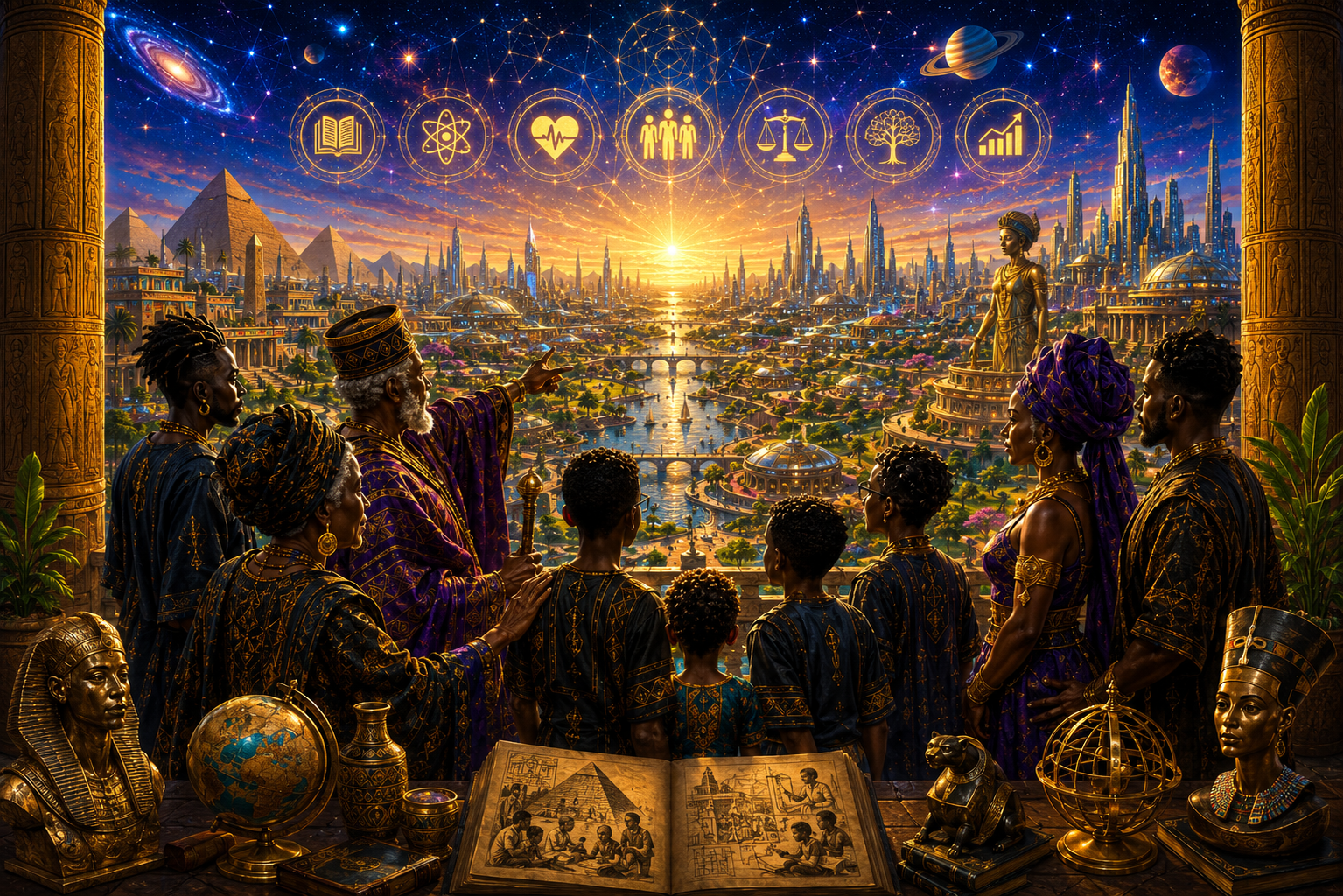
The warrior bloodline includes fighters, but it also includes farmers, midwives, builders, scholars, healers, sailors, mothers, fathers, artisans, merchants, spiritual leaders, and children who learned how to survive dangerous conditions.
Our ancestors are not only the famous names printed in history books. They are the people whose names may never have been recorded—the grandmother who fed several families, the father who worked two jobs, the teacher who bought supplies with her own money, the carpenter who trained young men, the mother who kept her children together under pressure, and the neighbor who made sure nobody went hungry.
Ancestry is biological, but legacy is also intellectual, cultural, spiritual, economic, and institutional. We inherit more than physical features. We inherit languages, recipes, survival strategies, beliefs, warnings, wounds, talents, responsibilities, and unfinished work.
The purpose of studying our ancestors is not to live in yesterday. It is to understand what yesterday placed in our hands.
Chancellor Williams: History as Warning and Blueprint
Chancellor Williams challenged Black people to study African history beyond the simplified story of enslavement and colonization. In The Destruction of Black Civilization, he examined the development of African societies, the pressures that weakened them, and the political, military, economic, and cultural forces that contributed to conquest and fragmentation. His work was meant as a direct challenge to teachings that presented African people as a people without meaningful history.
Williams’s message was not that Africa had once been perfect. African societies experienced conflict, rivalries, inequality, political mistakes, and internal division, just as every other civilization did.
His warning was that a people who refuse to study both their achievements and their failures may repeat the conditions that made them vulnerable.
From Williams, we learn that honoring the ancestors requires more than admiration. It requires organization. It requires political education, economic cooperation, disciplined leadership, protection of institutions, and the willingness to place collective survival above personal jealousy.
A civilization does not survive through pride alone. It survives through systems.
Cheikh Anta Diop: Reclaiming Africa’s Place in History
Cheikh Anta Diop confronted historical narratives that separated ancient African civilization from Black identity and treated Africa as a continent waiting to be civilized by outsiders.
Through history, anthropology, language, archaeology, and scientific inquiry, Diop argued for Africa’s central place in the development of human civilization. His scholarship placed particular attention on the Nile Valley and challenged historians to examine ancient Egypt within its African geographical and cultural environment. His work influenced wider efforts to reconstruct African history from African perspectives, including the intellectual movement represented by UNESCO’s General History of Africa.
Diop’s deeper lesson extends beyond any single debate about Egypt.
He taught that controlling historical interpretation affects how a people understand their intelligence, possibilities, and position in the world.
When Black children are taught that their history begins with chains, they may unconsciously associate Blackness with defeat. When they learn that African people built states, cities, trade networks, universities, spiritual systems, architecture, art, agriculture, medicine, and political institutions, the starting point changes.
That knowledge should not create fantasy or arrogance. It should create responsibility.
We must study Africa with pride and discipline—using archaeology, written records, oral tradition, language, material culture, and serious scholarly debate. Cultural pride becomes stronger when it can withstand honest examination.
Ivan Van Sertima: Expanding the Historical Question
Ivan Van Sertima encouraged readers to think beyond the boundaries imposed on African history. In They Came Before Columbus, he argued that Africans crossed the Atlantic and influenced parts of the Americas before the arrival of Christopher Columbus. He examined navigation, maritime knowledge, plants, cultural similarities, written accounts, and visual interpretations to build his case.
His central thesis remains disputed by many archaeologists and historians, and it should be studied alongside archaeological evidence, Indigenous histories, and scholarly criticism. Responsible ancestral study does not require accepting every claim without question. It requires reading the argument, examining the evidence, considering the criticism, and reaching conclusions with intellectual honesty.
Van Sertima’s lasting contribution was his refusal to accept the assumption that African people lacked the intelligence, maritime capacity, curiosity, or ambition to participate in global movement.
His work forces an important question: How many possibilities were dismissed because scholars began with the belief that Africans could not have accomplished them?
At the same time, respect for African history must never erase or minimize Indigenous civilizations. The peoples of the Americas possessed their own histories, technologies, religions, political systems, architecture, trade routes, and intellectual traditions.
The purpose of recovering African agency is not to steal agency from another people.
Tell the truth—even when the truth requires complexity.
Memory Must Produce Action
John Henrik Clarke taught generations to place African and African American history inside world history. Cheikh Anta Diop confronted the removal of Africa from the history of civilization. Chancellor Williams examined both the accomplishments of African societies and the conditions that contributed to their destruction. Ivan Van Sertima pushed readers to reconsider assumptions about African movement and global contact.
These scholars did not ask us to memorize their names and stop thinking.
They asked us to investigate.
A people taught to despise their past can be manipulated in the present. A people who romanticize the past without studying evidence can also be misled.
Our responsibility is to build disciplined historical knowledge: knowledge strong enough to inspire us, correct us, warn us, and guide our decisions.
Build the Family Archive
Ancestral recovery begins at home.
Learn the full names of your parents, grandparents, and great-grandparents. Ask where they were born, where they traveled, what work they performed, what land they owned, what institutions they joined, and what struggles they survived.
Interview elders while they are still able to tell their stories. Record their voices—with permission. Preserve photographs, letters, obituaries, certificates, recipes, military records, church programs, business documents, property records, school records, incarceration histories, and family traditions.
Write the names on the backs of old photographs. Unidentified faces can become lost history within one generation.
Create both a physical archive and a digital backup. Organize files by person, family branch, year, or event. Store copies in more than one secure place.
Oral history can deepen family research and preserve perspectives that may never appear in official records. Once living memory disappears without being recorded, part of the historical record disappears with it.
Do not wait until a funeral to begin asking questions.
The Ancestors Demand Responsibility
The ancestors should never become an excuse to avoid present responsibility.
Their sacrifices do not guarantee our success. They place a demand upon us.
It is easy to praise ancient builders while refusing to maintain our own homes. It is easy to honor warrior ancestors while avoiding discipline. It is easy to celebrate African kingdoms while failing to organize a functioning business, savings plan, family archive, or institution.
Ancestor reverence without responsibility becomes performance.
To honor the builder, become a builder.
To honor the scholar, study.
To honor the warrior, protect something valuable.
To honor the entrepreneur, circulate resources with discipline.
To honor the parent, prepare the next generation.
To honor the ancestors, become the kind of ancestor your descendants will be proud to remember.
The Real Question
The real question is not whether the ancestors are watching.
The real question is whether we are building anything worthy of being remembered.
What document will carry your thinking after you are gone?
What skill will remain in your family?
What business, property, institution, tradition, or principle will your descendants inherit?
What mistake will you correct before it becomes a generational pattern?
What truth will you preserve before somebody else rewrites it?
Memory becomes power only when it produces disciplined action.
K&K Reflection
Which family stories have not yet been recorded?
What strength or survival strategy did you inherit from previous generations?
What harmful pattern must end with you?
What skill, property, business, document, or principle can you transfer to the next generation?
What will your descendants learn about how you lived?
Continue Your Study
Chancellor Williams — The Destruction of Black Civilization
Cheikh Anta Diop — The African Origin of Civilization: Myth or Reality
Ivan Van Sertima — They Came Before Columbus
UNESCO — General History of Africa
Smithsonian National Museum of African American History and Culture — Family Oral History resources
Remember the ancestors. Study the evidence. Preserve the record. Build the inheritance. Protect the legacy.