

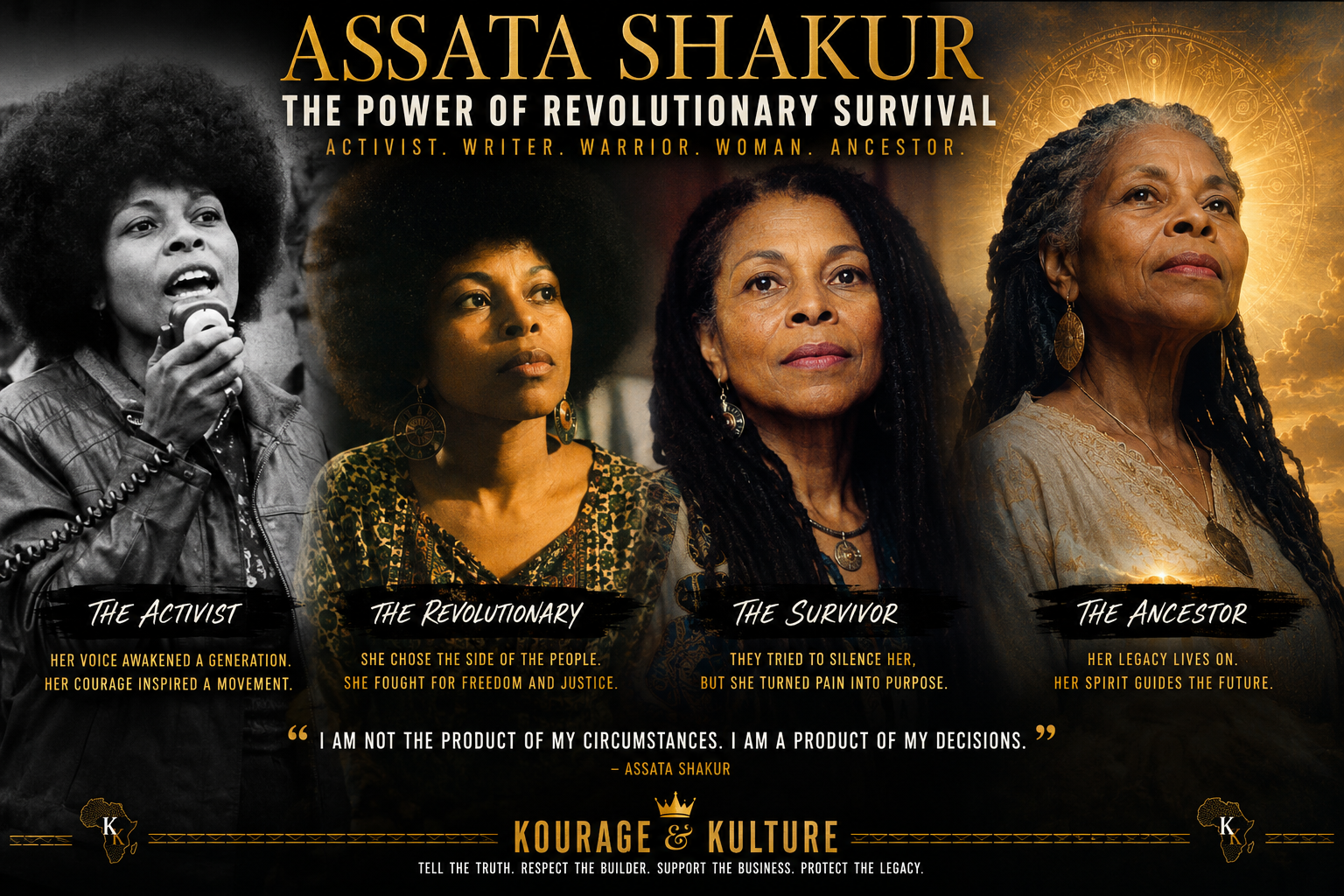
How Voice, Resistance, and Self-Determination Became a Living Legacy
Kourage & Kulture Monthly — August 2026 Issue
Theme: Black August: Warriors, Legacy & Liberation
4 Law Focus: Protect the Legacy
Assata Shakur’s story is not only about resistance. It is about the power of memory, survival, political consciousness, and the refusal to surrender one’s identity to the narratives of others.
The Woman Behind the Name
Black August calls us to remember individuals whose lives continue to shape conversations about justice, freedom, political consciousness, and self-determination. Among the most recognized names associated with that legacy is Assata Shakur, a woman whose life has inspired scholarship, debate, activism, literature, and cultural reflection for more than five decades.
Born JoAnne Deborah Byron on July 16, 1947, in New York City, she later became known as Assata Shakur, a name reflecting her evolving political and cultural identity. As a young woman, she witnessed racial inequality, economic hardship, and social unrest during one of the most transformative periods in American history. Those experiences helped shape her belief that meaningful change required both political education and community engagement.
During the late 1960s and early 1970s, Shakur became active in organizations dedicated to Black empowerment and social change, including the Black Panther Party and later the Black Liberation Army. Her activism centered on issues affecting Black communities, including education, economic justice, housing, and protection from discrimination. Like many activists of the era, she operated during a period marked by intense political conflict, government surveillance, and growing national debates over civil rights and public safety.
For supporters, Assata Shakur became a symbol of resilience and resistance. For others, her actions and legal history remain the subject of serious disagreement and ongoing public debate. Understanding her place in history requires examining both her activism and the legal events that continue to shape discussions about her life.
Black August encourages us to study history with honesty rather than assumption. Whether one approaches Assata Shakur through the lens of politics, law, culture, or social movements, her story remains an important part of understanding the complexities of America’s struggle over justice, identity, and freedom.
The New Jersey Turnpike Incident
On May 2, 1973, Assata Shakur, then known as JoAnne Chesimard, was traveling on the New Jersey Turnpike when a traffic stop led to a violent confrontation. During the exchange of gunfire, New Jersey State Trooper Werner Foerster and Black Liberation Army member Zayd Malik Shakur were killed. State Trooper James Harper was wounded, and Assata Shakur was also seriously injured.
The events of that morning quickly became one of the most closely examined criminal cases of the era. Prosecutors argued that Shakur was responsible for the death of Trooper Foerster, while Shakur consistently maintained her innocence regarding the shooting. Throughout her legal proceedings, she stated that she had been wounded during the confrontation and denied firing the weapon that killed the trooper.
Following a series of trials on multiple charges, some cases were dismissed or ended in acquittals. In 1977, however, Shakur was convicted in New Jersey state court of the murder of Trooper Foerster, along with related offenses connected to the incident. She was sentenced to life in prison plus additional years under New Jersey law.
The case has remained the subject of continuing legal, historical, and public discussion. Supporters have raised questions about aspects of the investigation, forensic evidence, witness testimony, and the broader political climate in which the trial occurred. Others maintain that the conviction was lawfully obtained and reflects the findings of the court. These differing perspectives continue to shape public understanding of the case decades later.
For historians, the New Jersey Turnpike incident represents more than a criminal prosecution. It reflects a period in American history when questions surrounding race, policing, political activism, constitutional rights, and public trust in government institutions often collided in ways that remain relevant today.
Exile, Writings, and a Legacy That Continues to Spark Debate
n 1979, Assata Shakur escaped from the Clinton Correctional Facility for Women in New Jersey with assistance from supporters. Her escape became one of the most widely reported prison breaks in modern American history and intensified national attention surrounding her case.
Several years later, Shakur received political asylum in Cuba, where she has lived for decades. The Cuban government has maintained its decision to provide her asylum, while the United States continues to seek her return. As a result, her status remains a subject of diplomatic discussion and legal interest.
While living in Cuba, Shakur authored Assata: An Autobiography, first published in 1987. In its pages, she recounts her childhood, political awakening, activism, imprisonment, and her perspective on the events that shaped her life. The autobiography has become an important primary source for scholars studying Black political movements, women’s activism, and the social conflicts of the 1960s and 1970s. Like many historical memoirs, it presents the author’s own experiences and viewpoints, inviting readers to compare them with court records, historical research, and other contemporary sources.
Beyond her autobiography, Shakur’s influence can be seen throughout literature, music, education, and popular culture. Her words have been quoted by artists, educators, activists, and community organizers who view her writings as reflections on identity, resilience, and the pursuit of dignity. Others continue to question or criticize the public recognition she receives because of her criminal conviction. These contrasting perspectives have ensured that her legacy remains a subject of ongoing public discussion.
Whether viewed through the lens of law, politics, history, or culture, Assata Shakur occupies a unique place in the American story. Her life continues to challenge readers to examine how societies remember conflict, interpret justice, and preserve history across generations.
“History becomes stronger when people are willing to study it from multiple perspectives, examine the evidence, and think critically rather than accept simple answers.”
What Black August Asks of Us
Black August is not a celebration of conflict. It is a season of study, discipline, remembrance, and personal responsibility. It calls each generation to examine history honestly, learn from the sacrifices and struggles of those who came before, and consider how that knowledge can be used to strengthen the future.
Assata Shakur’s story reminds us that history is often complex. It cannot always be understood through headlines, slogans, or brief summaries. Serious study requires patience, critical thinking, and the willingness to examine multiple perspectives before reaching conclusions.
For Kourage & Kulture, the lesson is larger than any single individual. Black August challenges us to become better readers, better builders, and better guardians of our communities. It reminds us that education is a lifelong responsibility, that economic ownership creates opportunity, and that strong institutions are built through consistent work rather than isolated moments of inspiration.
The responsibility of this generation is not to repeat history blindly, nor to ignore it because it is uncomfortable. Our responsibility is to understand it deeply enough to make wiser decisions for the future. Every business created, every child mentored, every family strengthened, every vote cast, every book studied, and every community institution preserved becomes part of that ongoing work.
The greatest tribute we can offer those remembered during Black August is not imitation—it is disciplined construction. We honor the past by becoming builders of the future.
“A people who study deeply build wisely. A people who build wisely leave a legacy no generation can erase.”
— Kourage & Kulture Editorial
The Blueprint Lives On
History does not ask us to become replicas of those who came before us. It asks us to become worthy stewards of the opportunities their sacrifices helped create.
Assata Shakur’s life continues to inspire discussion because it forces difficult questions about justice, identity, political activism, historical memory, and the responsibilities of citizenship. Whether readers ultimately agree with every aspect of her story or not, her life reminds us that history is rarely simple. It deserves careful study, intellectual honesty, and the courage to confront complexity without abandoning truth.
For Kourage & Kulture, Black August is not an invitation to live in the past. It is an invitation to build the future with greater wisdom. Every generation receives unfinished work. Some inherit stronger foundations than others, but every generation is measured by what it contributes—not only by what it inherits.
That contribution begins in ordinary places. It begins when a parent teaches integrity at the dinner table. It grows when an entrepreneur opens a business that creates opportunity for others. It expands when educators awaken curiosity, when artists preserve culture, when neighbors protect one another, and when communities choose cooperation over division. These daily acts of discipline become the architecture of lasting change.
The greatest revolutions are not sustained by moments alone. They endure through institutions that educate, businesses that employ, families that nurture, and leaders who understand that service is the highest expression of influence. A people who invest in these foundations create a legacy capable of surviving generations.
Black August reminds us to remember. Kourage & Kulture challenges us to build.
The blueprint has never belonged to one person.
It belongs to every generation willing to carry it forward with wisdom, discipline, compassion, and purpose.
The question is no longer what history has given us.
The question is:
What will history say about what we chose to build?
“We honor the past not by standing in its shadow, but by extending its light. Every article we publish, every truth we protect, every business we support, and every young mind we encourage is another brick in the foundation of tomorrow. The blueprint is now in our hands.”
— Kourage & Kulture Editorial Desk
The Four Laws of Kourage & Kulture
Tell the Truth.
Respect the Builder.
Support the Business.
Protect the Legacy.