
How the Black family transforms identity, discipline, responsibility and ancestral intelligence into a complete system of education.
BY SHABAZZ | KOURAGE & KULTURE
FOUR LAW FOCUS: RESPECT THE BUILDER • PROTECT THE LEGACY
A university is not defined only by buildings, professors or degrees. At its highest purpose, a university is a place where knowledge is gathered, tested, preserved and transferred to the next generation.
By that definition, the Black family was a university long before modern institutions claimed ownership of education.
Inside the family, a child first studies language, identity, responsibility, relationships, problem-solving and self-control. They learn how adults respond to pressure, manage resources, settle disagreements, honor elders, care for children and prepare for the future.
Every repeated family practice becomes part of the curriculum.
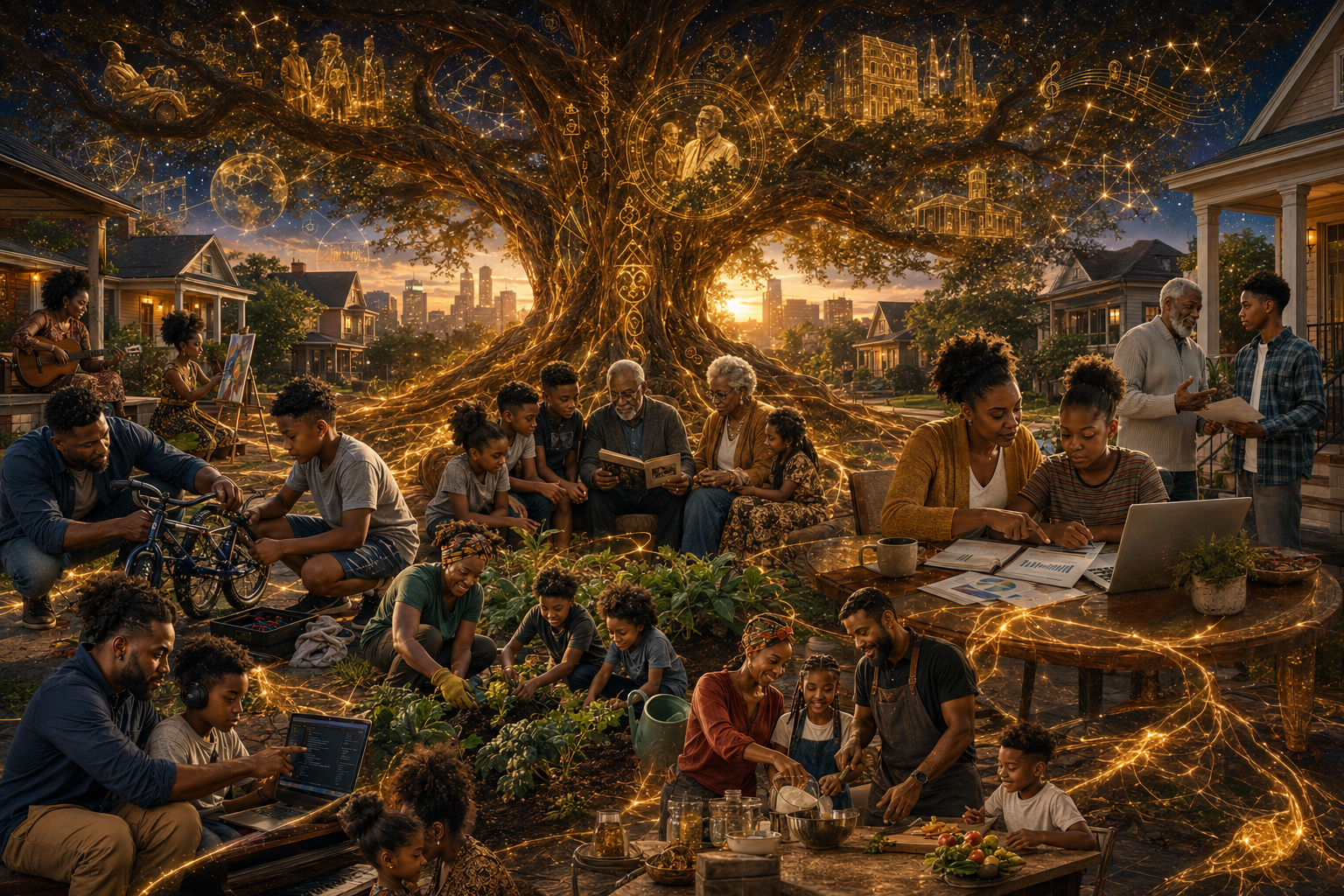
A child watching a parent repair something is studying mechanics. Helping prepare a meal introduces measurement, chemistry, health and cooperation. Listening to an elder explain a family photograph teaches history. Working in a garden teaches biology, patience and stewardship. Observing a family business introduces service, economics and ownership.
These lessons are powerful because they are not separated from life. Knowledge is immediately connected to action, responsibility and consequence.
The Black family becomes the first university when every generation understands that it has something valuable to teach—and something necessary to learn.
Every Generation Has a Department

A strong family does not treat wisdom as belonging to one age group.
Elders serve as the department of memory. They carry names, relationships, decisions, victories, mistakes and lessons that cannot be recovered once they are gone. Their responsibility is not simply to remember the past, but to explain its meaning.
Adults serve as the department of structure. They turn principles into schedules, standards, protection, budgets, routines and long-term plans. Children learn stability by observing whether adults consistently practice what they claim to value.
Young adults serve as the department of expansion. They introduce new technology, language, opportunities and ways of solving emerging problems. Their responsibility is to modernize the family’s methods without disconnecting from its foundation.
Children serve as the department of possibility. Their questions expose what adults have stopped examining. Their talents reveal where the family’s future may grow. Their imagination keeps inherited knowledge from becoming stagnant.
No generation is complete by itself.
Elders without young people possess knowledge with no destination. Young people without elders possess energy without memory. Adults connect the two by creating the structure through which wisdom can move forward.
The family becomes a university when every generation is respected as both a teacher and a student.
The Curriculum No School Can Replace

Schools can provide valuable instruction, but they cannot assume the Black family’s responsibility for preparing a child to understand who they are and what they must build.
The family curriculum must include subjects that directly protect life, identity and ownership.
Identity: Children should know their family names, origins, accomplishments, values and responsibilities. A child with a strong identity is less dependent upon strangers for a definition of worth.
Communication: Families must teach children how to listen, speak clearly, ask intelligent questions and resolve disagreement without destroying relationships.
Health: Young people need practical knowledge of nutrition, movement, rest, emotional regulation, hygiene and the care of their bodies.
Money: Children should learn how income is earned, how bills are paid, how budgets work and why saving, credit, insurance and investing matter.
Ownership: The family must explain the difference between consuming and building. Children should understand property, business, intellectual property and the long-term value of controlling what they create.
Technology: Young people should learn to use digital tools for research, production, communication and enterprise—not only entertainment.
Culture: Children must encounter Black literature, music, art, philosophy, spirituality, science and history as living sources of intelligence.
Community: Education must teach that talent carries responsibility. Knowledge should improve the individual, strengthen the family and produce value for the people.
When these subjects are taught consistently, the home becomes more than a place where relatives live.
It becomes an institution designed to produce capable human beings.
Build the Family University on Purpose
A family does not become an effective university through good intentions alone. Knowledge must be organized, practiced and preserved.
Start with a weekly family meeting. Use it to review schedules, responsibilities, finances, concerns and upcoming opportunities. Children should learn how decisions are made instead of believing that family life operates by accident.
Create a rotating teaching night. One family member might demonstrate a recipe, explain credit, teach a repair, share family history, introduce a computer skill or lead a physical-training session. Everyone should eventually teach.
Build a family archive. Preserve photographs, names, interviews, important documents, recipes, business records, property information and stories from elders. Store digital copies securely so the family’s memory does not disappear with one person.
Establish an ownership plan. Discuss saving, investing, insurance, estate planning, business development and property. Even when the family is beginning with limited resources, children should understand the direction in which the family is moving.
Measure growth through ability, not appearance. Ask what each person can now explain, create, repair, manage or teach that they could not do six months earlier.
The goal is not to imitate a school inside the home.
The goal is to make learning a natural part of how the family lives, solves problems and prepares its descendants.
The Degree Is Legacy
The Black family does not need permission to become an institution.
Its authority begins when relatives recognize that their collective knowledge, experience, talent and resources are valuable enough to organize and transfer.
Tell the Truth.
Tell children who their people are. Give them history without inferiority, correction without humiliation and confidence without deception.
Respect the Builder.
Honor the elders, parents, guardians and relatives who create stability, preserve knowledge and make sacrifices that may never receive public recognition.
Support the Business.
Turn family talent into economic structure. Purchase from Black businesses, teach enterprise, protect original ideas and help relatives convert skills into ownership.
Protect the Legacy.
Preserve the family’s records, property, stories, values and intellectual creations. Prepare the next generation to receive responsibility—not merely possessions.
A diploma recognizes what one person has completed.
A legacy proves what a family successfully transferred.
The Black family is the first university because it can educate the whole human being: identity, character, skill, discipline, culture, economics, relationships and purpose.
When the family teaches intentionally, every home becomes a campus, every elder becomes a library, every skill becomes a course and every child becomes the beginning of another generation of Black genius.